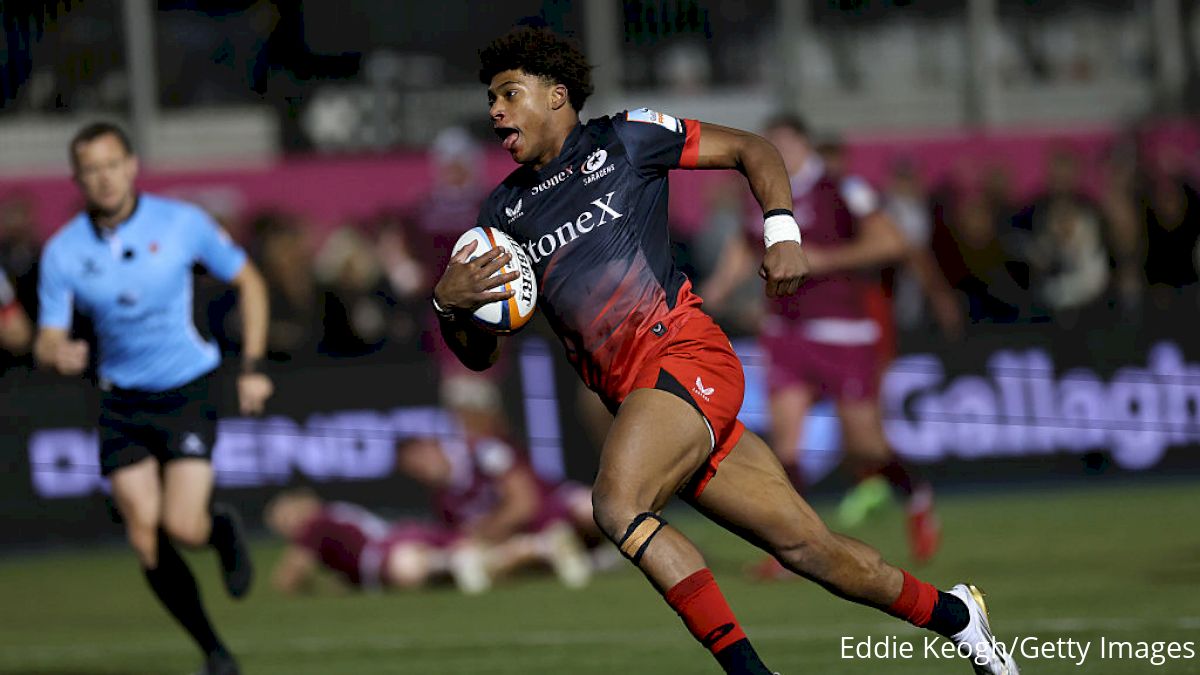
Saracens F.C. enter 2026-27 a fifth-place team whose underlying numbers looked much more like a champion. They went 10-8, missed the playoffs by six points and still finished with a +179 point differential, second only to Bath, while scoring 628 points, third most in the league.
The central question is whether Venter can turn that statistical superiority into the week-to-week efficiency Saracens lacked last season.
- Subscribe To FloRugby To Watch Rugby All Season Long
- What's Streaming On FloRugby? Take A Look At The Schedule
- The Best Rugby Players In The World 2026
It also arrives at a historic moment. Mark McCall’s 15-season run as director of rugby is over. Brendan Venter is back in charge. Sixteen players have departed across the senior and senior-academy groups, while Tomos Williams, George Martin and Alfie Barbeary headline a reload.
This is not a rebuild. Saracens still possess Maro Itoje, Ben Earl, Owen Farrell and an international-heavy pack. Their challenge is preserve the standards of one era while changing enough to avoid repeating its final frustration. Venter does not need to prove Saracens can dominate stretches of rugby. He needs to make domination produce wins consistently.
What 2025-26 Told Us About Saracens
Saracens finished on 57 points, behind Northampton, Bath, Exeter and Leicester, and their eight defeats kept them outside a four-team postseason. Yet only Bath bettered their point differential. Saracens scored more points than every PREM club except Northampton and Bath.
That gap between performance profile and results is the most useful lesson from 2025-26. Saracens were dangerous enough to destroy Bristol 50-17 early, beat Toulouse 20-14 at a sold-out StoneX Stadium in Europe and demolish Sale 85-19 away with 13 tries. They also absorbed a 62-15 league beating from Bath, lost 21-17 to Northampton at The Showdown and, after rebuilding their playoff challenge with four consecutive league wins, fell 32-12 at Exeter in the finale.
- Who Are Rugby's Highest-Paid Stars? Here Are The Biggest Contracts In The Sport
- When Are The Biggest Gallagher PREM Rivalry Matches? Derby Dates For The 2026-27 Season
- The Complete Gallagher PREM Schedule 2026-27: Fixtures, Key Dates, Holiday Matches & Playoffs
The same pattern appeared in the Champions Cup. Saracens beat Clermont 47-10 and Toulouse 20-14 at home but lost away to the Sharks and Glasgow. Seeded 13th for the knockouts, they went to Bath and lost 31-22 in the Round of 16.
Their identity had not vanished. Entering the final PREM round, Saracens led the competition with 155 turnovers won and 51 tackle turnovers. The pressure and disruption associated with their best teams still existed, and their scoring numbers showed more attacking capacity than the old “kick, defend, maul” stereotype.
What disappeared too often was ruthless conversion. Saracens could look championship-grade without producing a championship-grade record. Missing the playoffs was a disappointment. It was not evidence that the talent base had collapsed.
Brendan Venter Takes Over A Reloaded Saracens
McCall stepped down after a tenure that delivered six Premiership championships and three European Cups, remaining with Saracens as a technical adviser and board member. Venter returned as director of rugby, while head coach Joe Shaw and assistants Ian Peel, Adam Powell, Dan Vickers, Rob Webber and Dai Flanagan provide continuity beneath a major leadership change.
That structure makes tactical revolution unlikely. Venter inherits coaches, leaders and principles already embedded in the club. The more plausible reset is about precision: better decisions, clearer pressure, stronger game management and fewer performances in which Saracens fall far below their ceiling.
- Mark McCall's Saracens Era Ends, Leaving One Of Rugby's Biggest Jobs Open
- The 10 Biggest Players Leaving Gallagher PREM Rugby Before The 2026-27 Season
- Get More Saracens News All Season Long At FloRugby
The playing turnover is more dramatic. Tom Willis, Alex Lozowski, Theo McFarland, Marco Riccioni and Ivan van Zyl are among the confirmed departures. Willis is the loss because his carrying and reliability had become central to the pack. Riccioni’s exit matters because Saracens’ planned replacement, Jermain Ainsley, will not join.
The incoming class redistributes rather than obviously increases overall talent. Williams replaces van Zyl with elite pace and threat at scrum-half. Martin adds a 6-foot-6, 127kg England lock. Barbeary offers explosive carrying as the most natural new No. 8. Tom James gives Saracens an experienced reserve scrum-half who also can cover fly-half.
Saracens therefore look comparable in aggregate talent, but potentially more dangerous if the new combinations click. They improved at scrum-half and lock. They lost continuity in the midfield, back row and front row. Tighthead prop is the unresolved cost of that exchange.
Saracens Projected Starting XV For 2026-27
This is a projection of Saracens’ strongest opening PREM side, not an announced lineup. Noah Caluori is omitted because his wrist-surgery rehabilitation did not establish him as available for the league opener.
- Loosehead Prop — Rhys Carré
- Hooker — Theo Dan
- Tighthead Prop — Alec Clarey
- Lock — Maro Itoje (c)
- Lock — George Martin
- Blindside Flanker — Juan Martín González
- Openside Flanker — Ben Earl
- No. 8 — Alfie Barbeary
- Scrum-Half — Tomos Williams
- Fly-Half — Owen Farrell
- Left Wing — Tobias Elliott
- Inside Center — Nick Tompkins
- Outside Center — Lucio Cinti
- Right Wing — Max Malins
- Fullback — Elliot Daly
Projected Bench
- Jamie George
- Phil Brantingham
- Marcus Street
- Nick Isiekwe
- Andy Onyeama-Christie
- Tom James
- Fergus Burke
- Rotimi Segun
Hooker is the most fascinating selection call. Dan is an England hooker, while George remains a leader and set-piece resource. The back row is even more flexible: González, Earl and Barbeary offer range, speed and carrying, with Onyeama-Christie, Nathan Michelow and Toby Knight creating alternatives.
Farrell remains the clearest control option at fly-half, but Burke gives Saracens another attacking profile. Daly and Malins can move around the back three. Once Caluori is cleared, he challenges for a first-choice wing place after scoring 18 PREM tries last season.
The strongest depth is at lock and back row. The clearest concern is tighthead, where Clarey, Street, Corné Weilbach and younger options must replace Riccioni and compensate for Ainsley’s canceled arrival.
View this post on Instagram
The Players Who Make Saracens Go
Itoje remains the bridge between Saracens generations. He is club captain, an elite lock and a player whose lineout intelligence, defensive disruption, breakdown threat and work rate fit every version of Saracens rugby. Entering the campaign after a full preseason for the first time in more than a decade could be significant.
Earl gives the pack a different kind of violence: speed. Surrounded by Martin’s mass, Barbeary’s carrying and González’s range, he can attack transition moments and wider channels rather than simply function as another collision forward.
- FloRugby's Top 100 Rugby Players: Nos. 10-1 Reveal A New No. 1 In World Rugby
- Jordie Barrett, Finn Russell Lead FloRugby's Top 100 Rugby Players: Nos. 20-11
- Pieter-Steph du Toit Headlines FloRugby's Top 100 Rugby Players: Nos. 30-21
- Eben Etzebeth, Cam Roigard Lead FloRugby's Top 100 Rugby Players: Nos. 40-31
- Wallace Sititi, Handré Pollard Headline FloRugby's Top 100 Rugby Players: Nos. 50-41
- Ange Capuozzo, Josh van der Flier Lead FloRugby's Top 100 Rugby Players: Nos. 60-51
- Jack Willis Headlines FloRugby's Top 100 Rugby Players Rankings: Nos. 70-6
- Andrew Porter Headlines FloRugby's Top 100 Rugby Players Rankings: Nos. 80-71
- Grant Williams, Garry Ringrose Headline FloRugby's Top 100 Rugby Players: Nos. 90-81
- Nos. 100-91 Begin The Countdown To Rugby's Best
Williams may be the player who changes Saracens most. The Wales international and 2025 British & Irish Lion arrives after captaining Gloucester. His value is not merely fast service. He can attack lazy ruck defenders, create breaks himself and accelerate play before a defense resets. Pairing that instinct with Farrell’s control could give Saracens two distinct ways to dictate a match.
Farrell is no longer captain, but he remains the control tower. His kicking, decision-making and experience give Venter an on-field tactical voice capable of slowing a chaotic game or squeezing territory when required.
Martin looks designed for Saracens. Pairing his size and collision power with Itoje creates an imposing first-choice second row, while Isiekwe and Hugh Tizard provide rotation.
Then there is Caluori. The teenager’s 18-try breakthrough happened; 2026-27 is about whether he becomes something larger. Wrist surgery delays the start of that test, but a healthy Caluori adds a strike finisher capable of changing how defenses allocate space.
How Saracens Win In 2026-27
Saracens’ best description is pressure rugby with attacking upside. They want opponents repeatedly making decisions under stress: fielding contested kicks, exiting from uncomfortable positions, protecting isolated carriers and surviving breakdown pressure. Their league-leading turnover production entering last season’s final round proves that disruption remains foundational.
The difference this season could come after the pressure works. Williams gives Saracens a scrum-half who can exploit fractured defenses instead of always resetting shape. If Barbeary or Martin wins a collision and Williams finds a defense retreating around the ruck, Saracens can accelerate. If the picture is poor, Farrell can return them to territory and scoreboard management.
- Top 50 Rugby Union Prospects 2026: No. 10-1
- Top 50 Rugby Union Prospects 2026: No. 20-11
- Top 50 Rugby Union Prospects 2026: No. 35-21
- Top 50 Rugby Union Prospects 2026: No. 50-36
The pack makes both approaches credible. Itoje and Martin offer size and disruption at lock. González adds lineout athleticism. Earl brings speed. Barbeary supplies direct carrying. Dan and George give Venter two high-level hooker options. That combination should let Saracens play with power without becoming one-dimensional.
The fault line is tighthead. Pressure rugby becomes much harder when the scrum cannot provide stable possession or exits. Riccioni is gone, Ainsley is not coming, and the remaining rotation has to prove it can survive championship-level front rows.
The other challenge is efficiency. Saracens cannot treat last season’s differential as proof that regression automatically will rescue them. Their game must become more reliable when margins tighten. Winning turnovers and scoring heavily are valuable; controlling the moments that decide 17-14 matches is what turns those advantages into playoff seeding.
Why Saracens Can Win The Gallagher PREM
The championship case starts with their ceiling. A team that posted a +179 differential, scored 628 points and still missed the playoffs does not need imagination to become dangerous. It needs more of its best rugby on ordinary weekends.
Their spine is formidable. Itoje and Martin can anchor the pack. Earl and González provide mobility. Williams and Farrell offer a compelling contrast at halfback. Daly, Malins and eventually Caluori supply experience and finishing behind them.
View this post on Instagram
Depth in several key areas also matters. Isiekwe and Tizard protect the second row. George and Dan prevent hooker from becoming a succession crisis. James gives Williams experienced cover, while Burke keeps Farrell from being the only credible fly-half solution.
Most importantly, Saracens showed they can hurt elite teams. Toulouse discovered that at StoneX. Sale experienced the extreme version in an 85-19 demolition. Venter’s task is not to invent championship capability. It is to make that capability repeatable.
What Could Stop Saracens
Tighthead is the obvious structural concern, but integration is the broader one. Sixteen departures across the senior and senior-academy groups are significant. Saracens are replacing a starting scrum-half, an England No. 8, an international tighthead, a long-serving midfield organizer and a uniquely athletic forward in the same offseason that their director of rugby changes.
International selection adds another strain. Itoje, Earl, Dan, George, Isiekwe and Martin are established or recent England names; Williams and Carré have Wales exposure, while González and Cinti are Argentina internationals. The PREM Rugby Cup occupying part of the Nations Championship window mitigates some damage, but player load remains relevant.
Caluori’s rehabilitation also removes the most explosive young back from the assumed opening lineup. Saracens have options, but their back-three ceiling rises when he returns.
The most plausible reason they fall short, however, is simpler: last season’s inconsistency survives the reset. If Saracens remain a team capable of beating Toulouse and destroying Sale while also producing damaging low points, their talent will again exceed their place in the table.
Saracens 2026-27 Outlook
Saracens belong in the championship conversation, not above it. Northampton are defending champions, while Bath, Exeter and Leicester all finished ahead of them last season. A reasonable regular-season range is second through fifth, with a top-four return the sensible baseline expectation.
The most likely outcome is third or fourth and a PREM semifinal. A top-two finish and championship are realistic if Venter improves week-to-week efficiency quickly, Williams transforms the tempo at nine and the reshaped pack holds together. Another fifth- or sixth-place finish would be a significant disappointment.
Europe presents another demanding test. Saracens share Champions Cup Pool 2 with Toulouse, the 10bet Lions, Stade Rochelais, Exeter and Connacht, with same-league Exeter not a pool-stage opponent. The Round of 16 should be the floor; a quarterfinal is realistic; anything deeper requires the consistency missing last season.
For Year 1 under Venter, simply returning to the playoffs would represent progress, but it should not define the ambition. A competitive semifinal can qualify as success. A genuine title challenge would confirm that Saracens managed something harder than rebuilding: changing generations without surrendering relevance.
That is what makes this season compelling. Saracens are neither the old dynasty intact nor a young club waiting for some distant window. They are a reloaded contender trying to transfer a winning culture from McCall’s era into Venter’s second act. The talent is already sufficient. How far Saracens go will depend on whether their ruthlessness finally matches their ceiling.
Saracens 2026-27 Schedule: Every Gallagher PREM And Champions Cup Match
Saracens 2026-27 Gallagher PREM Schedule
- Round 1: Leicester Tigers vs. Saracens, Sept. 27, 2026
- Round 2: Saracens vs. Sale Sharks, Oct. 4, 2026
- Round 3: Saracens vs. Bristol Bears, Oct. 10, 2026
- Round 4: Harlequins vs. Saracens, Oct. 25, 2026
- Round 5: Saracens vs. Newcastle Red Bulls, Oct. 30, 2026
- Round 6: Saracens vs. Northampton Saints, Dec. 5, 2026
- Round 7: Gloucester Rugby vs. Saracens, Dec. 19, 2026
- Round 8: Exeter Chiefs vs. Saracens, Dec. 27, 2026
- Round 9: Saracens vs. Bath Rugby, Jan. 2, 2027
- Round 10: Newcastle Red Bulls vs. Saracens, weekend of Jan. 23, 2027
- Round 11: Saracens vs. Harlequins, March 20, 2027
- Round 12: Northampton Saints vs. Saracens, March 27, 2027
- Round 13: Saracens vs. Leicester Tigers, April 17, 2027
- Round 14: Sale Sharks vs. Saracens, weekend of April 24, 2027
- Round 15: Bristol Bears vs. Saracens, May 8, 2027
- Round 16: Saracens vs. Exeter Chiefs, weekend of May 15, 2027
- Round 17: Saracens vs. Gloucester Rugby, May 29, 2027
- Round 18: Bath Rugby vs. Saracens, weekend of June 5, 2027
Saracens 2026-27 Champions Cup Pool Schedule
- Champions Cup Round 1: Connacht Rugby vs. Saracens, Oct. 17, 2026
- Champions Cup Round 2: Saracens vs. Stade Rochelais, Dec. 12, 2026
- Champions Cup Round 3: Saracens vs. 10Bet Lions, Jan. 10, 2027
- Champions Cup Round 4: Stade Toulousain vs. Saracens, Jan. 17, 2027
Saracens 2026-27 Frequently Asked Questions
How Can Rugby Fans In The United States Watch Saracens On FloRugby?
Rugby fans in the United States can watch Saracens throughout the 2026-27 season on FloRugby, with matches also available to stream through the FloSports app.
What League Do Saracens Play In?
Saracens play in the Gallagher PREM, the top level of professional club rugby in England.
Where Did Saracens Finish In The 2025-26 Gallagher PREM?
Saracens finished fifth in the 2025-26 Gallagher PREM with a 10-8 record and 57 points. They missed the four-team playoffs by six points despite finishing with a +179 point differential, second best in the league, and scoring 628 points, third most.
Who Is The Saracens Director Of Rugby?
Brendan Venter is Saracens' director of rugby for 2026-27. He replaced Mark McCall, who stepped down after 15 consecutive seasons in charge and remains with Saracens as a technical adviser and board member.
Who Is The Saracens Head Coach?
Joe Shaw is the Saracens head coach. He remains part of a largely continuous coaching structure under Venter.
Who Is The Saracens Captain?
Maro Itoje is the Saracens captain. Itoje took over the captaincy in 2024-25 and continues in the role entering 2026-27.
Where Do Saracens Play Their Home Matches?
Saracens play their home matches at StoneX Stadium in Hendon, North London.
What European Competition Are Saracens Playing In?
Saracens are competing in the 2026-27 Investec Champions Cup. Their Pool 2 opponents are Toulouse, 10Bet Lions, Stade Rochelais, Exeter Chiefs and Connacht. Because clubs from the same domestic league do not play each other in the pool phase, Saracens' four playable opponents are Toulouse, the Lions, La Rochelle and Connacht.
When Does Saracens' 2026-27 Gallagher PREM Season Start?
Saracens open their Gallagher PREM season on the road against Leicester Tigers on Sept. 27, 2026. It will be their first PREM match since Venter returned as director of rugby.
Did Saracens Make The 2026 Gallagher PREM Playoffs?
No. Saracens finished fifth with 57 points and missed the four-team playoffs. Their playoff hopes lasted until the final round, when Exeter Chiefs beat Saracens 32-12.
How Did Saracens Do In The 2025-26 Champions Cup?
Saracens reached the Round of 16. They beat Clermont 47-10 and Toulouse 20-14 at home during pool play but lost away to the Hollywoodbets Sharks and Glasgow Warriors. Bath eliminated Saracens with a 31-22 victory in the Round of 16.
Who Are Some Saracens Players To Know In 2026-27?
Captain Maro Itoje, Ben Earl, Owen Farrell, Tomos Williams and George Martin are among Saracens' most important established players. Noah Caluori is the young star to watch after scoring 18 PREM tries during his breakthrough 2025-26 season, although he enters the new campaign recovering from wrist surgery.
Who Did Saracens Sign For 2026-27?
Saracens' major additions include Tomos Williams from Gloucester, George Martin from Leicester Tigers, Alfie Barbeary from Bath and Tom James from Northampton Saints. They also added tighthead Corné Weilbach and midfielder Sione Va'enuku. Williams is arguably the most transformative addition because of the threat and tempo he can bring at scrum-half.
Who Left Saracens Before The 2026-27 Season?
Saracens confirmed 16 departures across their senior and senior-academy groups. The most significant include Tom Willis, Theo McFarland, Ivan van Zyl, Alex Lozowski and Marco Riccioni. Willis is the biggest loss after developing into an England international and an important No. 8 for Saracens.
Is Jermain Ainsley Playing For Saracens In 2026-27?
No. Saracens initially announced the signing of tighthead prop Jermain Ainsley from Lyon, but the agreement subsequently was terminated for personal reasons. He will not join Saracens for 2026-27.
What Is Different About Saracens In 2026-27?
The biggest change is the end of McCall's 15-season run as director of rugby and Venter's return to the role. Saracens also have reshaped their playing spine, replacing players including Willis, van Zyl and Riccioni with additions such as Barbeary, Williams and Martin.
What Is Saracens' Biggest Question Entering 2026-27?
Whether Saracens can turn their underlying performance into enough victories to return to the playoffs. They finished only fifth last season despite having the PREM's second-best point differential and third-highest scoring total. Tighthead depth after Riccioni's departure and Ainsley's canceled move is another significant concern.