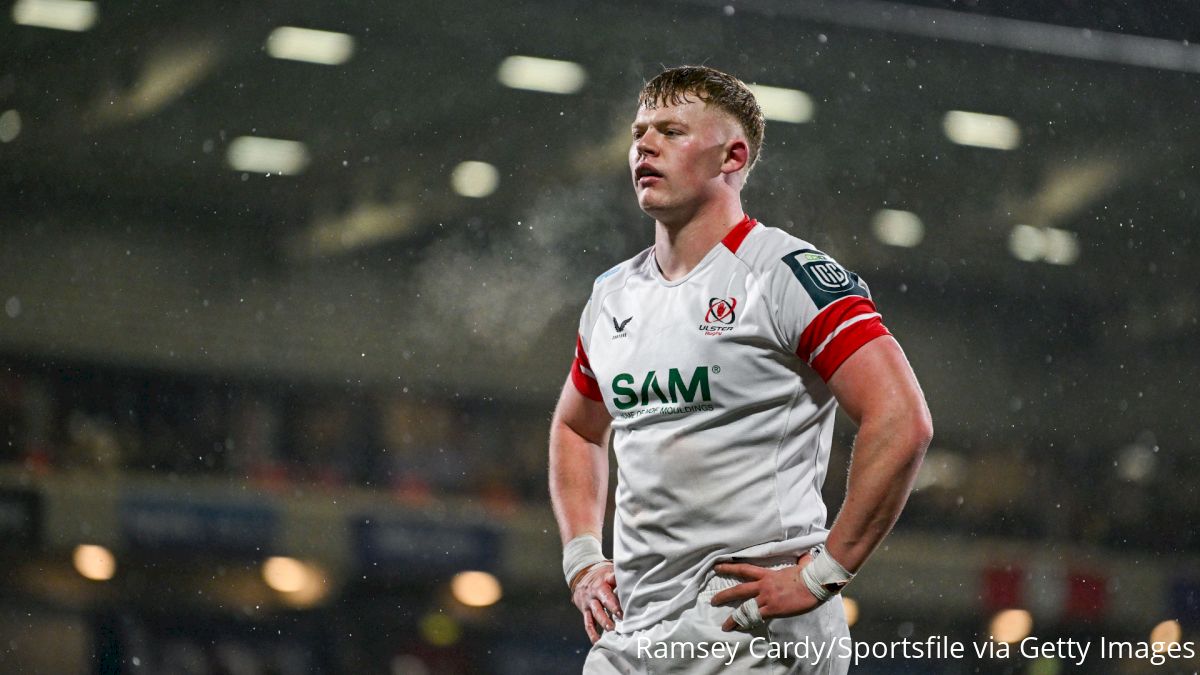
Ulster Rugby spent 2025-26 proving their rebuild had substance. Now comes the harder part: proving it can win.
Richie Murphy's side improved from 14th to ninth in the United Rugby Championship, jumped from 38 table points to 52, flipped a minus-92 points differential into plus-74 and reached the EPCR Challenge Cup final. Ulster scored 494 URC points and 72 tries, numbers that belonged much higher than ninth.
Yet they missed the playoffs by two points and finished their European run with a 59-26 loss to Montpellier.
- Subscribe To FloRugby To Watch Rugby All Season Long
- What's Streaming On FloRugby? Take A Look At The Schedule
- The Best Rugby Players In The World 2026
That contradiction defines Ulster entering 2026-27. The attack already looks capable of carrying a playoff team. The roster is deeper, the pathway is producing legitimate senior talent and Belfast remains capable of generating major nights. But front-five control, defensive consistency, game management and the quality of the full 23 still separate Ulster from the URC's best.
This is no longer a season in which progress alone should satisfy. Ulster should make the playoffs. How much further they travel depends on whether the less glamorous parts of their game finally catch up with their dangerous backline.
What 2025-26 Told Us About Ulster Rugby
Ulster's 9-1-8 URC record does not fully capture how dramatic the improvement was. They scored 80 more points than in 2024-25, conceded 86 fewer and produced a 166-point swing in differential. They collected 10 try bonus points and finished only two points behind eighth-place Connacht.
More importantly, Ulster showed they could hurt strong teams. They beat the Bulls 28-7, won 34-26 at the Sharks, crushed Munster 28-3 and won away at Connacht and Edinburgh. Against South African opponents they went 2-1-1 with a positive differential, undermining any simplistic idea that physical southern opposition was automatically their problem.
- Who Are Rugby's Highest-Paid Stars? Here Are The Biggest Contracts In The Sport
- The Complete United Rugby Championship 2026-2027 Schedule: Every Fixture, Derby And Key Date
- URC Rivalries To Watch In 2026-2027: The Biggest Derby Matches On The Schedule
The real dividing line was quality and consistency. Ulster went 4-1-6 against eventual playoff teams and 5-2 against non-playoff opposition. Their home differential was plus-89; away it was minus-15. They could produce excellent road performances, but their bad away days deteriorated badly.
Europe made the progress tangible. Ulster topped their Challenge Cup pool, then beat Ospreys, La Rochelle and Exeter to reach the final. Montpellier's 59-26 victory in Bilbao exposed the remaining gap in power and depth.
The simplest comparison is Glasgow. Ulster scored 494 league points to Glasgow's 479, but conceded 420 to Glasgow's 338. Ulster did not need a new attacking identity. They needed to stop giving so much back.
What Changed For Ulster Rugby In 2026-27
Ulster's offseason was built around depth and structural need rather than superstar collecting. Eli Snyman strengthens lock, Eduardo Bello and Keynan Knox deepen tighthead, Matthew Devine gives Nathan Doak real competition at scrum-half, Jamie Benson challenges at fly-half and Chay Mullins replenishes the back three. Ben Donnell adds forward versatility, while Daniel Hawkshaw and Martin Moloney increase options further.
That recruitment matters because Ulster's worst moments last season often came when injuries exposed the drop from the strongest XV to the rest of the squad. The newcomers should make positions 16 through 30 more credible.
View this post on Instagram
But the departures matter. Werner Kok leaves after scoring 10 URC tries and earning Elite XV selection. More structurally important is Angus Bell's exit. Ulster have several plausible ways to replace Kok's wing minutes; they do not have an obvious like-for-like replacement for Bell's front-row quality at loosehead.
Injury complicates the picture. Captain Iain Henderson will miss the opening months after hip surgery, while Bryn Ward, Juarno Augustus and Jude Postlethwaite underwent offseason operations.
There is also institutional reinforcement. Clarke Dermody arrives as forwards coach, Rory Best runs professional rugby operations as general manager and Joe Schmidt has a coach-development advisory role. Schmidt is not running the senior team week to week, but his presence adds expertise across the wider pathway.
Did Ulster improve? Their depth and balance probably did. Their best XV did not obviously become more talented. That makes coaching, development and healthy returns crucial.
Ulster Rugby Projected Starting XV For 2026-27
This is a projection of Ulster's strongest lineup when the squad is healthy, not an announced team.
- Loosehead Prop — Eric O'Sullivan
- Hooker — Tom Stewart
- Tighthead Prop — Tom O'Toole
- Lock — Iain Henderson
- Lock — Cormac Izuchukwu
- Blindside Flanker — David McCann
- Openside Flanker — Nick Timoney
- No. 8 — Juarno Augustus
- Scrum-Half — Nathan Doak
- Fly-Half — Jack Murphy
- Left Wing — Jacob Stockdale
- Inside Center — Stuart McCloskey
- Outside Center — James Hume
- Right Wing — Zac Ward
- Fullback — Michael Lowry
Projected Bench
- Rob Herring
- Sam Crean
- Eduardo Bello
- Eli Snyman
- Bryn Ward
- Matthew Devine
- Jamie Benson
- Robert Baloucoune
Several calls are extremely tight. Snyman could start at lock and almost certainly will carry major early-season responsibility while Henderson recovers. Devine is strong enough to challenge Doak rather than merely cover him. Benson has a genuine opportunity to beat Murphy to the No. 10 shirt. Baloucoune, Ward and Stockdale make wing selection unusually competitive.
Hooker, tighthead, back row, center and back three offer strong depth. Loosehead is the clearest concern. Lock is deeper numerically than last year, but its top-end quality becomes vulnerable without Henderson or Izuchukwu. Players such as Ben Carson, Jude Postlethwaite, Ethan McIlroy, Chay Mullins and James McNabney give Murphy meaningful alternatives outside this 23.
The Players Who Make Ulster Rugby Go
Stuart McCloskey remains the attacking reference point. Ulster's 2025-26 Player of the Year and an Elite XV selection, he gives the backline a carrier who can win contact without reducing the attack to straight-line rugby. His ability to carry, distribute at the gain line and create favorable space outside makes Ulster's width more dangerous.
Cormac Izuchukwu may be even more important early. With Henderson unavailable, the 6-foot-7 lock/blindside has to supply lineout value, carrying and athleticism in a pack already under scrutiny. Another injury to Izuchukwu would be especially difficult to absorb.
- FloRugby's Top 100 Rugby Players: Nos. 10-1 Reveal A New No. 1 In World Rugby
- Jordie Barrett, Finn Russell Lead FloRugby's Top 100 Rugby Players: Nos. 20-11
- Pieter-Steph du Toit Headlines FloRugby's Top 100 Rugby Players: Nos. 30-21
- Eben Etzebeth, Cam Roigard Lead FloRugby's Top 100 Rugby Players: Nos. 40-31
- Wallace Sititi, Handré Pollard Headline FloRugby's Top 100 Rugby Players: Nos. 50-41
- Ange Capuozzo, Josh van der Flier Lead FloRugby's Top 100 Rugby Players: Nos. 60-51
- Jack Willis Headlines FloRugby's Top 100 Rugby Players Rankings: Nos. 70-6
- Andrew Porter Headlines FloRugby's Top 100 Rugby Players Rankings: Nos. 80-71
- Grant Williams, Garry Ringrose Headline FloRugby's Top 100 Rugby Players: Nos. 90-81
- Nos. 100-91 Begin The Countdown To Rugby's Best
Tom O'Toole anchors tighthead with proven international quality, while Tom Stewart can give Ulster a powerful red-zone weapon at hooker. Nick Timoney supplies work rate, defensive activity and back-row flexibility.
Then there are the players who can change Ulster's ceiling. Doak led their URC scoring with 102 points and now faces useful pressure from Devine. Zac Ward scored 11 league tries and 15 across all competitions. Bryn Ward has the highest long-term ceiling among the emerging forwards.
But no development matters more tactically than fly-half. If Murphy or Benson becomes a reliable high-level URC 10, Ulster gain a controller capable of winning matches when their running game is not dictating terms. If the position remains unsettled into spring, championship talk becomes difficult.
How Ulster Rugby Win
Ulster are most dangerous when they create speed before moving the defense laterally. McCloskey and the forwards generate gain-line momentum, the ball reaches width quickly and a deep group of outside backs attacks space before defensive connections reset.
That suits Stockdale, Baloucoune, Zac Ward and Lowry. Ward's sevens background translates naturally into broken-field danger. Lowry can punish poor kick chase. The centers give Murphy several combinations capable of carrying or distributing.
The problem is that elite rugby eventually asks whether a team can win when that picture disappears.
Ulster's front five did not consistently control matches against the best packs. A secondary statistical review during last season ranked them 14th in scrum success and 10th in lineout accuracy. Leinster built a 29-0 lead in Belfast behind forward control, while Montpellier magnified the issue in the Challenge Cup final.
View this post on Instagram
Defense was the other tax on Ulster's ambition. The Lions scored 49 despite Ulster scoring five tries. That points toward transition defense, collision work and connection rather than attacking failure.
Then comes game-state management. Scarlets won late. Cardiff took their European pool meeting with a late penalty. Stormers rescued a draw with an 80th-minute penalty try. Glasgow won the final league game by four.
Ulster can create enough opportunities. The next step is controlling territory, set piece, discipline and endings well enough that they do not need to keep creating them.
Why Ulster Rugby Can Succeed — And What Could Stop Them
The optimistic case begins with evidence, not projection. Ulster already improved by 14 table points and 166 points of differential in one season. They already scored more league points than Glasgow. They already reached a European final.
Their backline is playoff quality, McCloskey is among the league's most influential centers, and the back row could become a major strength if Augustus and Bryn Ward return well. Recruitment addressed actual weaknesses instead of simply adding names. Ten Ulster players were called into Ireland's summer 2026 squad, another sign that the talent base is broadening.
Belfast can still change major games. Bulls, Munster, Racing 92, La Rochelle and Exeter all experienced that last season. If Ulster turn a 5-1-3 home league record into seven or eight wins, the playoff mathematics change quickly.
- Top 50 Rugby Union Prospects 2026: No. 10-1
- Top 50 Rugby Union Prospects 2026: No. 20-11
- Top 50 Rugby Union Prospects 2026: No. 35-21
- Top 50 Rugby Union Prospects 2026: No. 50-36
The most plausible failure, however, does not require the attack to regress. Henderson's absence could stretch the locks. Loosehead could struggle against powerful scrums. The young fly-halves could remain inconsistent. The defense could continue conceding enough to turn four-try performances into coin flips.
International recognition also creates a depth test. Ulster want more Ireland players, but every additional call-up makes the lower half of the roster more important.
Most of all, the pack must become reliably neutral against elite opposition. Ulster do not need to dominate Leinster or the Stormers up front. They cannot repeatedly allow those teams to decide where and how the match is played.
The schedule will test that proposition immediately. After opening against Edinburgh, Ulster travel to Glasgow, host Munster, then face consecutive URC trips to the Bulls and Stormers. That sequence can expose the pack before Henderson returns. The Christmas and January block demands rotation, with Cardiff, Ospreys, Connacht, Leinster, Sharks and another Connacht meeting surrounding Challenge Cup fixtures.
Direct games against Connacht matter after the western province took eighth by two points last season. The May finish is revealing: Leinster at home, Munster away and the Lions in Belfast. Ulster do not need to dominate every contender to advance. They need to collect more points from these head-to-head playoff games, avoid road collapses and arrive in spring controlling their qualification rather than depending on others.
Ulster's 2026-27 Outlook
Ulster belong in the URC's playoff conversation, not among its preseason championship favorites. Leinster, Stormers, Bulls and Glasgow begin with stronger contender credentials, while Munster remain ahead of Ulster in the Irish hierarchy. Ulster's realistic range is approximately sixth through ninth.
Eighth should be the minimum acceptable outcome. Sixth or better would represent more meaningful progress because it improves the quarterfinal matchup and demonstrates that Ulster can separate themselves from the crowded playoff middle. A top-four finish would be a breakthrough. A semifinal is plausible if the draw and development curve cooperate.
- Every Irish Derby On The 2026-2027 United Rugby Championship Schedule
- Angus Bell Wins URC Try Of The Season For Solo Stunner
- Montpellier Cruises Over Ulster To Secure 2026 EPCR Challenge Cup Trophy
The Challenge Cup offers another opportunity. After reaching last season's final, failing to make the knockouts would be a major disappointment. Another deep run is realistic, although returning to Champions Cup qualification through URC performance would say more about the rebuild's health than another second-tier European final.
Success therefore means making the URC playoffs, preferably sixth or higher, remaining dangerous in Europe and showing that the front five and defense can survive knockout-level pressure. Missing the playoffs again, absent an extraordinary injury crisis, would be failure.
The biggest reason for optimism is that Ulster no longer need to invent a way to threaten good teams. They already have one. The biggest concern is that their weaknesses live in the areas that decide close, high-level matches.
That is why 2026-27 feels different. The question is no longer whether Murphy's rebuild is working. The improvement is too substantial to deny. The question is whether Ulster can convert development into standings points before “promising” becomes another form of standing still. This is an attacking, improving, increasingly deep team whose season will be determined by whether its forwards, defense and halfbacks can make the hard parts of winning as reliable as the spectacular ones.
Ulster Rugby 2026-27 Schedule: Every URC And Challenge Cup Match
Ulster Rugby 2026-27 URC Schedule
- Round 1: Ulster vs. Edinburgh, Sept. 25, 2026
- Round 2: Glasgow Warriors vs. Ulster, Oct. 3, 2026
- Round 3: Ulster vs. Munster, Oct. 10, 2026
- Round 4: Bulls vs. Ulster, Oct. 24, 2026
- Round 5: Stormers vs. Ulster, Oct. 31, 2026
- Round 6: Cardiff vs. Ulster, Dec. 5, 2026
- Round 7: Ulster vs. Ospreys, Dec. 18, 2026
- Round 8: Ulster vs. Connacht, Dec. 27, 2026
- Round 9: Leinster vs. Ulster, Jan. 2, 2027
- Round 10: Ulster vs. Sharks, Jan. 22, 2027
- Round 11: Connacht vs. Ulster, Jan. 30, 2027
- Round 12: Dragons vs. Ulster, Feb. 25, 2027
- Round 13: Ulster vs. Zebre Parma, March 20, 2027
- Round 14: Benetton vs. Ulster, March 27, 2027
- Round 15: Ulster vs. Scarlets, April 17, 2027
- Round 16: Ulster vs. Leinster, April 23, 2027
- Round 17: Munster vs. Ulster, May 8, 2027
- Round 18: Ulster vs. 10Bet Lions, May 14, 2027
Ulster Rugby 2026-27 Challenge Cup Pool Schedule
- Challenge Cup Round 1: Zebre Parma vs. Ulster, Oct. 17, 2026
- Challenge Cup Round 2: Ulster vs. Aviron Bayonnais, Dec. 12, 2026
- Challenge Cup Round 3: USAP Perpignan vs. Ulster, Jan. 10, 2027
- Challenge Cup Round 4: Ulster vs. Dragons, Jan. 16, 2027
Ulster Rugby 2026-27 Frequently Asked Questions
How Can Rugby Fans In The United States Watch Ulster Rugby On FloRugby?
Rugby fans in the United States can watch Ulster throughout the 2026-27 season on FloRugby, with matches also available to stream through the FloSports app.
What League Does Ulster Rugby Play In?
Ulster play in the United Rugby Championship, which features professional teams from Ireland, South Africa, Wales, Scotland and Italy.
Where Did Ulster Finish In The 2025-26 URC?
Ulster finished ninth in the 2025-26 URC regular season with a 9-1-8 record and 52 table points. They finished two points behind eighth-place Connacht and missed the playoffs.
Who Is The Ulster Rugby Head Coach?
Richie Murphy is Ulster's head coach. He enters his third full season after guiding Ulster from 14th in 2024-25 to ninth in 2025-26 and reaching the Challenge Cup final.
Who Is The Ulster Rugby Captain?
Iain Henderson is Ulster's captain. The veteran lock will miss the opening months of the 2026-27 season following hip surgery.
Where Does Ulster Rugby Play Its Home Matches?
Ulster play their home matches at Affidea Stadium in Belfast. The 18,196-capacity ground remains widely known by its historic name, Ravenhill.
What European Competition Is Ulster Playing In?
Ulster are competing in the 2026-27 EPCR Challenge Cup. Their Pool 1 opponents include Toyota Cheetahs, USAP Perpignan, Dragons, Aviron Bayonnais and Zebre Parma, although Ulster do not play every team in the six-club pool.
When Does Ulster's 2026-27 URC Season Start?
Ulster open their 2026-27 URC season against Edinburgh at Affidea Stadium on Sept. 25, 2026.
Did Ulster Make The 2026 URC Playoffs?
No. Ulster finished ninth with 52 points, two points behind eighth-place Connacht.
How Did Ulster Do In Europe In 2025-26?
Ulster reached the 2025-26 EPCR Challenge Cup final after knockout victories over Ospreys, La Rochelle and Exeter. Montpellier defeated Ulster 59-26 in the final in Bilbao.
Who Are Some Ulster Rugby Players To Know In 2026-27?
Stuart McCloskey, Cormac Izuchukwu, Tom O'Toole, Nick Timoney and Nathan Doak are among Ulster's most important players. Zac Ward scored 11 URC tries last season, while young back row Bryn Ward is one of the province's most intriguing emerging players.
Who Did Ulster Sign For 2026-27?
Ulster's additions include Eduardo Bello, Keynan Knox, Eli Snyman, Ben Donnell, Matthew Devine, Jamie Benson and Chay Mullins. Daniel Hawkshaw and Martin Moloney also joined the senior setup later in the offseason.
Who Left Ulster Before The 2026-27 Season?
Ulster confirmed 11 senior departures, including Angus Bell, Werner Kok, John Andrew, David Shanahan, Marcus Rea, James Humphreys and Matthew Dalton. Bell and Kok are particularly significant losses after important 2025-26 seasons.
What Is Ulster's Biggest Question Entering 2026-27?
Whether their forwards, defense and game management can catch up with an attack that already produced playoff-caliber numbers. Ulster scored 494 points and 72 tries last season but conceded 420 points and still finished ninth.
Can Ulster Make The URC Playoffs In 2026-27?
Ulster should be considered a playoff-caliber team. The realistic finishing range of sixth through ninth and considers missing the playoffs again a failure barring an extraordinary injury crisis.