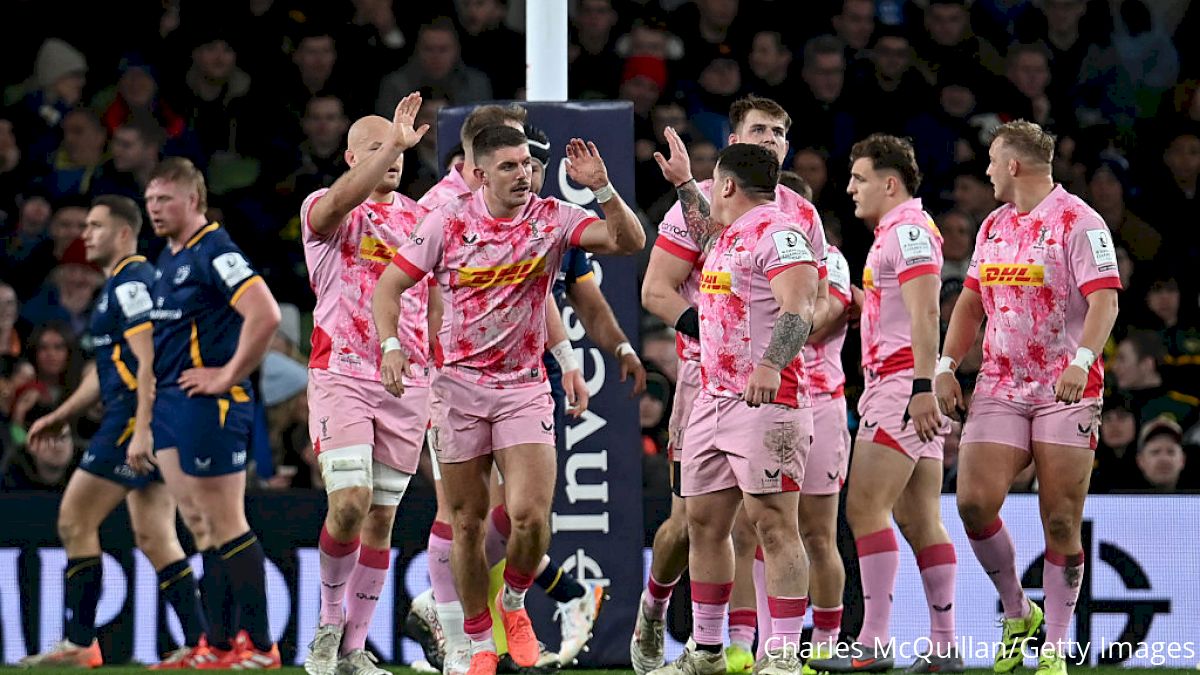
Harlequin F.C. spent 2025-26 looking like two different rugby teams sharing the same shirt.
One finished ninth in the Gallagher PREM, lost 12 of 18 league matches and conceded 589 points. The other demolished Bayonne and Stormers in Europe, won at La Rochelle, scored 76 against Newcastle and ended its domestic season by beating the eventual PREM champion Northampton Saints.
- Subscribe To FloRugby To Watch Rugby All Season Long
- What's Streaming On FloRugby? Take A Look At The Schedule
- The Best Rugby Players In The World 2026
That contradiction defines everything about Harlequins entering 2026-27.
Marcus Smith remains the attacking centerpiece. George Furbank has arrived to give him another elite playmaker. Alex Dombrandt, Chandler Cunningham-South, Cadan Murley and a deep collection of dangerous backs give Harlequins enough weapons to overwhelm opponents.
Yet another spectacular backline matters only so much when a team has been conceding nearly 33 league points per match.
That is why Harlequins' most important offseason acquisition may ultimately be structure rather than another player. Robbie Deans has arrived as performance director above retained head coach Jason Gilmore, while the specialist coaching operation has been extensively rebuilt.
The central question is whether they can make Harlequins more dependable without making them less Harlequins.
What 2025-26 Told Us About Harlequins
Forget reputation. Harlequins were a bad league team last season.
They finished ninth of 10 at 6-12, collected 31 points and were outscored 589-448. Their minus-141 differential was not the statistical profile of a contender that happened to lose several close games. Quins averaged 24.9 points scored and 32.7 conceded.
Yet they scored 64 tries, demonstrating why their season requires more explanation than the table provides.
The campaign began amid disruption when Danny Wilson left the rugby operation immediately before the season and defensive coach Gilmore suddenly inherited the leading role. Harlequins never established consistency afterward.
- Who Are Rugby's Highest-Paid Stars? Here Are The Biggest Contracts In The Sport
- When Are The Biggest Gallagher PREM Rivalry Matches? Derby Dates For The 2026-27 Season
- The Complete Gallagher PREM Schedule 2026-27: Fixtures, Key Dates, Holiday Matches & Playoffs
By late March they were ninth and lost 26-19 at home to Gloucester in a match where set-piece pressure and failures to capitalize on attacking opportunities illustrated recurring problems. Then, without Smith, they beat Bristol 18-14 and showed they could survive a tighter contest.
The volatility continued. Quins crushed Newcastle 76-17 and Exeter 41-24, lost 26-12 to Saracens, then defeated Northampton 38-31.
Europe made the contradiction even sharper.
Harlequins lost their Champions Cup opener 45-28 at Leinster before destroying Bayonne 68-14 and Stormers 61-10. They then won 27-17 at La Rochelle before Sale eliminated them 26-17 at The Stoop in the Round of 16.
The lesson was unmistakable. Harlequins possessed contender-level performances without contender-level repeatability.
Robbie Deans Leads A Real Harlequins Reset
Harlequins did not respond to ninth place by simply replacing Gilmore.
Instead, they built around him.
Former Australia coach Robbie Deans became performance director, with an arrangement running through 2027-28. Brad Cooper took charge of attack, Rob Hunter the forwards, Sean Long skills and transition and Jordan Turner-Hall defense. Nick Evans departed after 2025-26, while Toby Booth's consultancy ended.
That overhaul gives Harlequins an opportunity to address their problems without discarding the attacking identity that makes their ceiling so enticing.
The roster changed significantly, too.
- FloRugby's Top 100 Rugby Players: Nos. 10-1 Reveal A New No. 1 In World Rugby
- Jordie Barrett, Finn Russell Lead FloRugby's Top 100 Rugby Players: Nos. 20-11
- Pieter-Steph du Toit Headlines FloRugby's Top 100 Rugby Players: Nos. 30-21
- Eben Etzebeth, Cam Roigard Lead FloRugby's Top 100 Rugby Players: Nos. 40-31
- Wallace Sititi, Handré Pollard Headline FloRugby's Top 100 Rugby Players: Nos. 50-41
- Ange Capuozzo, Josh van der Flier Lead FloRugby's Top 100 Rugby Players: Nos. 60-51
- Jack Willis Headlines FloRugby's Top 100 Rugby Players Rankings: Nos. 70-6
- Andrew Porter Headlines FloRugby's Top 100 Rugby Players Rankings: Nos. 80-71
- Grant Williams, Garry Ringrose Headline FloRugby's Top 100 Rugby Players: Nos. 90-81
- Nos. 100-91 Begin The Countdown To Rugby's Best
Furbank is the marquee arrival from Northampton and potentially transforms the geometry of the attack. James Dun arrives from Bristol to reinforce a second row losing substantial experience. South African tighthead Ruan Swiegers adds competition in another area requiring greater stability.
But this was hardly an offseason of pure accumulation.
Harlequins announced a large departing class including Tom Lawday, Stephan Lewies, Jordan Els, Joe Launchbury and Jarrod Evans. Lewies' departure combined with Launchbury's retirement strips experience and leadership from the second row, while Evans' exit leaves uncertainty behind Smith.
The verdict is therefore nuanced: Harlequins' strongest XV appears better, especially with Furbank, but the overall squad is not clearly deeper.
Harlequins Projected Starting XV For 2026-27
This is a projection of Harlequins' strongest Matchday 23 assuming availability, not an announced lineup.
- Loosehead Prop — Fin Baxter
- Hooker — Jack Walker
- Tighthead Prop — Pedro Delgado
- Lock — Kieran Treadwell
- Lock — Guido Petti
- Blindside Flanker — Chandler Cunningham-South
- Openside Flanker — Will Evans
- No. 8 — Alex Dombrandt
- Scrum-Half — Will Porter
- Fly-Half — Marcus Smith
- Left Wing — Cadan Murley
- Inside Center — Luke Northmore
- Outside Center — Oscar Beard
- Right Wing — Rodrigo Isgrò
- Fullback — George Furbank
Projected Bench
- Sam Riley
- Reserve loosehead unresolved
- Will Collier/Ruan Swiegers
- James Dun
- Jack Kenningham
- Backup scrum-half unresolved
- Bryn Bradley
- Tyrone Green
The unresolved reserve loosehead and scrum-half positions are deliberate because the available roster evidence does not establish sufficiently clear hierarchies to force names into those roles.
Furbank versus Green shapes the back-three discussion, although both should have substantial roles. Evans versus Kenningham gives Gilmore contrasting openside options. Lock is another significant competition after the departures of Lewies and Launchbury.
Harlequins possess particularly attractive back-three and back-row choices. Their greater concern is what happens when international selection and rotation reach thinner areas, especially scrum-half, fly-half and parts of the front five.
Marcus Smith And George Furbank Can Change The Attack
Smith remains Harlequins' center of gravity.
Entering the penultimate PREM round last season, he had scored 115 league points, fourth-most at that stage, while converting 42 of 54 attempts at goal. He produced 21 points himself during the Newcastle rout.
But the most interesting question is no longer simply what Smith can create.
It is what happens when he does not have to create everything.
Furbank arrives as a playmaking fullback capable of becoming another distributor behind the primary attacking line. Pairing him with Smith potentially allows Harlequins to present defenses with multiple decision-makers rather than continually funneling possession through their fly-half.

Dombrandt is crucial to that equation because his carrying and linking can connect the pack with Smith. Cunningham-South supplies direct power, giving Quins a way to create momentum rather than relying exclusively upon deception.
Murley provides established finishing quality, while Isgrò offers another physical international presence.
Up front, Baxter and Petti may be just as important. Baxter is an enhanced-EPS England loosehead on a team that cannot afford another season of unreliable set-piece foundations. Petti's experience becomes more valuable following the second-row departures.
Cassius Cleaves is the breakout player worth watching. His first-team Cup impact already includes two tries on his home debut against Sale, although an unusually crowded back three may initially limit opportunities.
How Harlequins Win Matches
Harlequins are most dangerous when their forwards create enough front-foot possession for their playmakers to attack before defenses become organized.
That sounds simple. Their personnel makes it difficult to defend.
Dombrandt can link, Cunningham-South can punch through the gain line and Smith can manipulate the first defensive layer. Furbank potentially supplies another distributor from depth. Murley and Isgrò can finish opportunities, while Green offers another dangerous back-three alternative.
That combination can produce scoring avalanches. Bayonne, Stormers and Newcastle discovered that last season.
The problem comes when opponents deny Harlequins the platform necessary to unleash it.
- Top 50 Rugby Union Prospects 2026: No. 10-1
- Top 50 Rugby Union Prospects 2026: No. 20-11
- Top 50 Rugby Union Prospects 2026: No. 35-21
- Top 50 Rugby Union Prospects 2026: No. 50-36
Gloucester exposed them through forward and set-piece pressure. Saracens demonstrated how difficult Quins could find matches against opponents capable of controlling physical exchanges and momentum.
The 18-14 victory over Bristol consequently matters almost as much as any blowout. Harlequins won without Smith and without turning the match into an attacking festival. Championship-level teams need that alternative route.
Defense remains the largest tactical issue. Conceding 589 points meant Harlequins routinely demanded extraordinary offensive production merely to stay competitive.
The new staff does not need to eliminate risk. It needs to make ordinary attacking performances sufficient to win.
Why Harlequins Can Climb The Gallagher PREM
The strongest argument for Harlequins is that their ninth-place finish did not reveal their maximum level.
They demonstrated their ceiling repeatedly against serious opposition.
Winning at La Rochelle matters. Beating Northampton matters. Their Champions Cup pool performance matters. This was not a bottom-table roster incapable of competing with high-level teams.
Now Furbank adds another dimension to an already dangerous backline, while Deans and the reconstructed coaching staff represent a substantial attempt to solve the structural weaknesses around it.
The back row also offers quality and variety. Dombrandt, Cunningham-South, Evans and Kenningham give Gilmore different combinations without sacrificing established senior ability.
Europe provides another opportunity. Harlequins drop from the Champions Cup into Challenge Cup Pool 3 after winning three Champions Cup pool matches last season. A club that has already won the Challenge Cup three times has legitimate reason to view another deep run as attainable.
Harlequins therefore possess two pathways to a meaningful season: domestic rebound and European contention.
What Could Stop Harlequins
The greatest danger is believing talent automatically fixes volatility.
Harlequins' defense must improve substantially. Their set piece must withstand opponents determined to slow matches and turn them into physical contests. The reconstructed second row must replace leadership as well as minutes.
Availability could magnify every depth concern.
Smith, Baxter and Furbank hold enhanced England EPS contracts. Murley and Cunningham-South were also involved with England during 2026, while Delgado, Petti, Boris Wenger and Isgrò had recent Argentina involvement.
That does not mean everyone disappears simultaneously. It does mean Harlequins must survive stretches when their strongest lineup is unavailable.
Smith's understudy is particularly important. Jarrod Evans' departure removes an experienced alternative behind a fly-half who serves as chief playmaker, tactical organizer and principal goal kicker.
The plausible failure scenario is therefore straightforward: defensive improvement proves modest, forward instability persists and international absences expose a squad that lost considerable experience.
Then Smith and company are back where they started, being asked to produce exceptional rugby too frequently.
Harlequins 2026-27 Outlook
Harlequins should improve, but ninth to championship favorite is too large a leap to assume.
Their realistic regular-season range is fourth through seventh, with fifth or sixth the strongest central expectation. A top-four finish would represent major progress and put an extremely dangerous attacking team into knockout rugby. Another bottom-three finish would signal that the reset failed to solve fundamental problems.
The Challenge Cup may offer the clearer trophy opportunity. A quarterfinal or semifinal run is reasonable; reaching or winning the final sits within their credible ceiling.
Success does not require a trophy. A playoff berth would be unequivocal success after ninth. Fifth accompanied by substantial defensive improvement and a deep European run would also demonstrate genuine progress.
Disappointment would be another season in which spectacular victories obscure structural failure.
Harlequins enter 2026-27 as a high-ceiling rebound team rather than an established contender. Smith and Furbank could give them one of the PREM's most fascinating attacks, but their fate will be determined elsewhere: defense, set piece, depth and control.
The challenge for Deans, Gilmore and their new staff is not teaching Harlequins how to produce brilliant rugby.
It is making brilliant rugby matter because everything surrounding it finally works often enough.
Harlequins 2026-27 Schedule: Every Gallagher PREM And Challenge Cup Match
Harlequins 2026-27 Gallagher PREM Schedule
- Round 1: Bath Rugby vs. Harlequins, Sept. 25, 2026
- Round 2: Harlequins vs. Gloucester Rugby, Oct. 3, 2026
- Round 3: Harlequins vs. Sale Sharks, Oct. 11, 2026
- Round 4: Harlequins vs. Saracens, Oct. 25, 2026
- Round 5: Harlequins vs. Exeter Chiefs, Oct. 31, 2026
- Round 6: Leicester Tigers vs. Harlequins, Dec. 5, 2026
- Round 7: Harlequins vs. Bristol Bears, Dec. 20, 2026
- Round 8: Northampton Saints vs. Harlequins, Dec. 28, 2026
- Round 9: Harlequins vs. Newcastle, Jan. 2, 2027
- Round 10: Gloucester Rugby vs. Harlequins, Jan. 22, 2027
- Round 11: Saracens vs. Harlequins, March 19, 2027
- Round 12: Exeter Chiefs vs. Harlequins, March 26, 2027
- Round 13: Harlequins vs. Northampton Saints, April 16, 2027
- Round 14: Bristol Bears vs. Harlequins, April 23, 2027
- Round 15: Newcastle vs. Harlequins, May 7, 2027
- Round 16: Harlequins vs. Bath Rugby, May 14, 2027
- Round 17: Sale Sharks vs. Harlequins, May 28, 2027
- Round 18: Harlequins vs. Leicester Tigers, June 5, 2027
Harlequins 2026-27 Challenge Cup Pool Schedule
- Challenge Cup Round 1: Harlequins vs. RC Vannes, Oct. 18, 2026
- Challenge Cup Round 2: Ospreys vs. Harlequins, Dec. 12, 2026
- Challenge Cup Round 3: Edinburgh Rugby vs. Harlequins, Jan. 9, 2027
- Challenge Cup Round 4: Harlequins vs. RC Toulon, Jan. 15, 2027
Harlequins 2026-27 Frequently Asked Questions
How Can Rugby Fans In The United States Watch Harlequins On FloRugby?
Rugby fans in the United States can watch Harlequins throughout the 2026-27 season on FloRugby, with matches also available to stream through the FloSports app.
What League Do Harlequins Play In?
Harlequins play in the Gallagher PREM, the top level of professional club rugby in England.
Where Did Harlequins Finish In The 2025-26 Gallagher PREM?
Harlequins finished ninth of 10 teams in the 2025-26 Gallagher PREM with a 6-12 record and 31 table points. They scored 448 points, conceded 589 and finished with a minus-141 points differential. They did not qualify for the playoffs.
Who Is The Harlequins Head Coach?
Jason Gilmore is the Harlequins head coach entering the 2026-27 season. Former Australia head coach Robbie Deans has joined the club as performance director as part of a significant restructuring of the rugby operation.
Who Is The Harlequins Captain?
Alex Dombrandt is the incumbent Harlequins leadership figure entering 2026-27.
Where Do Harlequins Play Their Home Matches?
Harlequins play their home matches at Twickenham Stoop in southwest London. The ground has a commonly listed capacity of approximately 14,800.
Harlequins also stage their annual Big Game at Allianz Stadium. Big Game 18 is scheduled for Dec. 28, 2026, against reigning Gallagher PREM champion Northampton Saints.
What European Competition Are Harlequins Playing In?
Harlequins are competing in the 2026-27 EPCR Challenge Cup after playing in the Investec Champions Cup in 2025-26. Quins are in Pool 3 with Ospreys, Edinburgh Rugby, Black Lion, RC Toulon and RC Vannes.
When Does Harlequins' 2026-27 Gallagher PREM Season Start?
Harlequins open their 2026-27 Gallagher PREM season against Bath at Twickenham Stoop on Sept. 25, 2026.
Their first competitive fixture of the season is a PREM Rugby Cup match against Leicester Tigers at The Stoop on Sept. 5.
Did Harlequins Make The 2026 Gallagher PREM Playoffs?
No. Harlequins finished ninth in the 2025-26 Gallagher PREM and did not qualify for the playoffs.
When Did Harlequins Last Win The Gallagher PREM?
Harlequins most recently won the English league championship in 2021. They have won the English league championship twice in the professional era.
Who Are Some Harlequins Players To Know In 2026-27?
Marcus Smith remains Harlequins' biggest star and attacking centerpiece. Alex Dombrandt, Fin Baxter, Chandler Cunningham-South, Cadan Murley and Guido Petti are other established players central to the squad.
George Furbank is the marquee new signing, while young back Cassius Cleaves is a breakout candidate to watch.
Who Did Harlequins Sign For 2026-27?
Harlequins' verified senior additions include England international fullback George Furbank from Northampton Saints, second-row James Dun from Bristol Bears and South African tighthead prop Ruan "Sampie" Swiegers from the Airlink Pumas.
Furbank is the headline addition because his playmaking from fullback potentially gives Harlequins another high-level distributor alongside Marcus Smith.
Who Left Harlequins Before The 2026-27 Season?
Major departures include Tom Lawday, Stephan Lewies, Jordan Els, Joe Launchbury and Jarrod Evans. Launchbury retired, while the combined departures of Launchbury and Lewies remove considerable experience and leadership from the second row.
How Did Harlequins Perform At Home And Away In 2025-26?
Individual results show the inconsistency at The Stoop: Gloucester won there 26-19, while Harlequins also produced huge European victories over Bayonne and Stormers and finished the PREM season by beating Northampton 38-31 at home.
How Did Harlequins Perform In Europe In 2025-26?
Harlequins went 3-1 during the Investec Champions Cup pool stage. They lost 45-28 at Leinster before beating Bayonne 68-14, Stormers 61-10 and La Rochelle 27-17.
That earned Harlequins a home Round-of-16 match, where Sale Sharks eliminated them with a 26-17 victory at The Stoop.
How Many Tries Did Harlequins Score In The 2025-26 Gallagher PREM?
Harlequins scored 64 tries during the 2025-26 Gallagher PREM season despite finishing ninth. They averaged approximately 24.9 points scored per match but conceded approximately 32.7, illustrating the gap between their attacking ceiling and defensive consistency.
What Is The Biggest Question Facing Harlequins In 2026-27?
The biggest question is whether Harlequins can establish a reliable defensive and set-piece foundation around one of the Gallagher PREM's most dangerous collections of attacking players.
Quins conceded 589 league points last season despite producing enormous wins domestically and in Europe. The arrival of Robbie Deans and the reconstructed coaching staff is designed to make those high-end performances more repeatable.