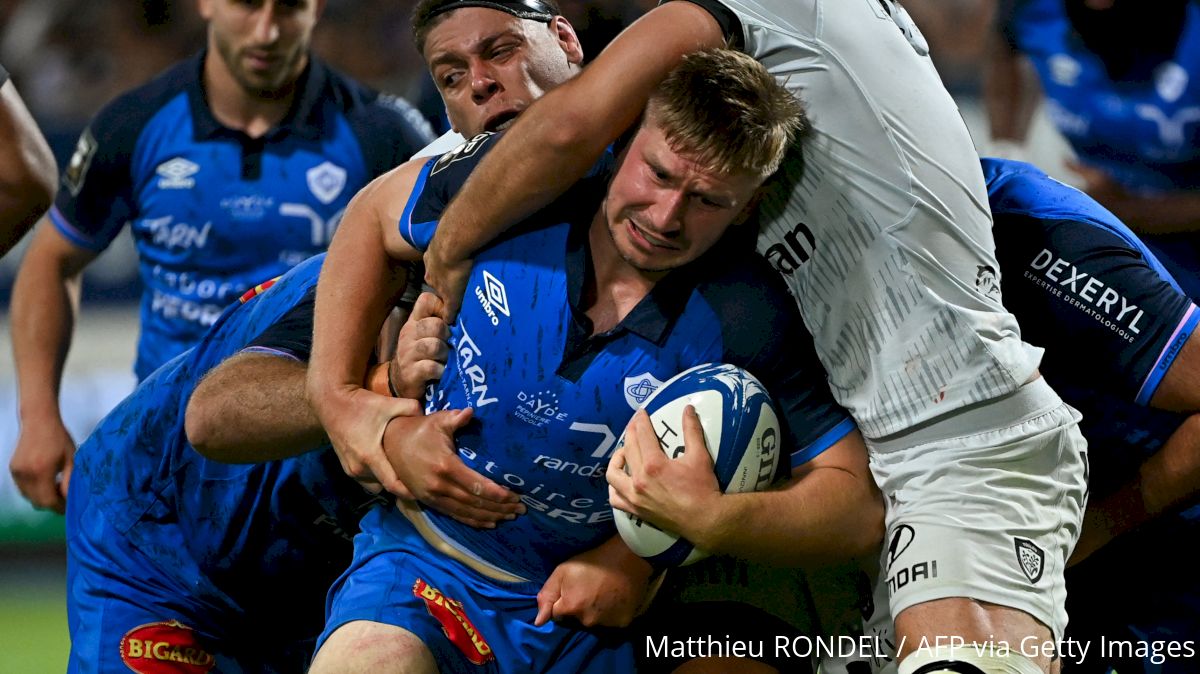
Castres Olympique spent 2025-26 proving two seemingly contradictory things. It remained capable of beating serious opposition, winning away at La Rochelle and Bayonne and producing a memorable Champions Cup victory at Munster. But over 26 Top 14 rounds, the consistency disappeared. Castres finished 10th with 55 points, four places below its playoff finish from the previous season.
That leaves Castres in familiar territory entering 2026-27: dangerous enough that nobody should dismiss it, but with enough obvious flaws to keep expectations under control. An aggressive offseason strengthened the pack, although the Achilles injury suffered by marquee signing Dalton Papali'i removed the centerpiece of that recruitment drive for roughly six months.
- Subscribe To FloRugby To Watch Rugby All Season Long
- What's Streaming On FloRugby? Take A Look At The Schedule
- The Best Rugby Players In The World 2026
- Top 50 Rugby Union Prospects 2026: No. 10-1 | FloRugby Rankings
Castres remains one of French rugby's enduring small-city competitors, a five-time French champion continuously established among the country's elite since around 1990. The question for Xavier Sadourny's team is not whether it possesses enough talent to trouble the Top 14's best. Last season answered that. The question is whether Castres can become consistent enough — particularly away from Stade Pierre-Fabre — to turn isolated statement victories back into a playoff campaign.
What Castres' 2025-26 Season Revealed
The numbers explain why Castres fell from sixth in 2024-25 to 10th.
Castres went 11-15, scoring 660 points and conceding 751 for a minus-91 differential. Its 81 tries showed considerable attacking capacity, but allowing 96 tries made sustained success difficult.
The home-road divide was even more revealing. Castres went 8-5 at Pierre-Fabre, outscoring opponents 396-301. Away, it went 3-10 and was outscored 450-264.
View this post on Instagram
There were genuine highs. Castres beat Bayonne 48-17 at home, won at La Rochelle 19-17 and closed the league season by beating Toulon 38-21. In Europe, it defeated Edinburgh 33-0 and Munster 31-29 before scoring 41 points in a 49-41 Champions Cup Round of 16 loss at Northampton.
But the league season unraveled between Rounds 17 and 25, when Castres went 1-8. Road defeats at Toulouse, Clermont, Bordeaux-Bègles and Racing 92 produced a combined score of 231-79.
That is the central lesson from 2025-26. Castres had enough attacking threat and big-match capability. It did not have the defensive consistency to survive an entire Top 14 campaign.
Castres Transfers And Offseason Changes
Castres responded by investing heavily in its forwards.
Former All Blacks captain Dalton Papali'i arrived as the marquee addition, but his preseason Achilles rupture and expected six-month absence forced an immediate adjustment. Castres answered by signing Hamish Watson, the veteran Scotland flanker and 2021 British & Irish Lion.
Prop Alex Burin adds tighthead competition, while lock Chris Gabriel brings size and carrying ability. Kyllian Ringuet strengthens the back row, and France U20 prop Maël Turpin adds developmental front-row depth. Center Taylor Gontineac arrives after 86 Pro D2 appearances and 18 tries with Béziers.
Théo Vidal may prove particularly important. The 26-year-old was named the best player in the National championship in 2025-26 before joining Castres' professional group.
That matters because Pierre Popelin left for Vannes and Enzo Hervé was loaned to Montauban. Louis Le Brun and Vidal are the only fly-halves listed on the current official roster. Other departures include retired prop Antoine Tichit, Aurélien Azar, Romain Macurdy, Tyler Ardron, Nathanaël Hulleu and veteran lock Leone Nakarawa.
Castres also retained important pieces. Baptiste Delaporte extended through 2030, Guillaume Ducat through 2029, Loris Zarantonello through 2029 and Rémy Baget through 2029, among several new deals.
Sadourny remains head coach, but his staff has changed. Julien Tastet has expanded responsibility for the forwards and lineout, Davit Zirakashvili has arrived to work on the scrum and set piece, and Fabrice Estebanez now oversees defense and contact.
On paper, Castres looks deeper and stronger up front. Papali'i's injury prevents the offseason from being an unqualified success, while the reduced fly-half depth creates a significant vulnerability.
Castres Projected Starting XV And Bench
This is a projection of Castres' strongest available 23 entering the season, not a confirmed lineup.
- Quentin Walcker, prop
- Loris Zarantonello, hooker
- Will Collier, prop
- Tom Staniforth, lock
- Guillaume Ducat, lock
- Baptiste Delaporte, back row
- Hamish Watson, flanker
- Abraham Papali'i, back row
- Santiago Arata, scrum-half
- Louis Le Brun, fly-half
- Christian Ambadiang, wing
- Jack Goodhue, center
- Vilimoni Botitu, center
- Vuate Karawalevu, wing
- Théo Chabouni, fullback
- Castres Projected Bench
Projected bench options: Teddy Durand, Loïs Guérois, Alex Burin, Florent Vanverberghe, Mathieu Babillot/Kyllian Ringuet, Jérémy Fernandez, Taylor Gontineac and Rémy Baget.
The greatest competition is in the pack. Babillot brings significant leadership experience, Ringuet strengthened his case by scoring against Montpellier in preseason and Vanverberghe can challenge Ducat in the second row.
Once Dalton Papali'i returns, the back-row equation changes again. Delaporte, Watson, Abraham Papali'i, Dalton Papali'i and Babillot give Sadourny numerous potential combinations.
Castres Players To Watch
Santiago Arata
Santiago Arata remains central to Castres' ability to dictate tempo. The Uruguay scrum-half had reached 85 Castres appearances when his extension through 2029 was announced, and he scored both in the final league match of 2025-26 and the preseason victory over Montpellier.
Christian Ambadiang
Christian Ambadiang emerged as Castres' leading individual attacking threat. By April 10, he had scored 10 tries in 16 appearances, including two against Northampton in the Champions Cup.
Tom Staniforth
Tom Staniforth enters the season with enhanced status after playing in all three of France's summer Nations Championship matches against New Zealand, Australia and Japan.
Baptiste Delaporte
Baptiste Delaporte remains a central figure in the club's identity. He joined the Castres youth system in 2011, debuted professionally in 2017 and became the youngest captain in club history at 22. His new contract runs through 2030.
Louis Le Brun
Louis Le Brun may be the player Castres can least afford to lose. His importance has increased after Popelin's departure and Hervé's loan. Vidal's arrival offers an intriguing alternative, but Le Brun enters the season as the established option at a position with little proven Top 14 depth.
How Castres Olympique Plays
Castres' reputation as a forward-oriented side does not fully explain the 2025-26 team. Eighty-one league tries, Ambadiang's finishing, Botitu's midfield threat and Arata's ability around the breakdown show a team capable of hurting opponents with the ball.
Its 48-17 victory over Bayonne illustrated the best version. Castres had only 46% possession and 43% territory but scored seven tries and stole four Bayonne lineouts. Castres did not need to dominate the ball; it needed to create disruptive moments and convert them.
The 16-12 loss at Toulon showed the opposite. Castres had 57% possession and 61% territory but could not turn that control into victory.
The driving maul remains an important weapon. Arata scored from maul pressure against Toulon in the 2025-26 finale, and Zarantonello scored from another maul against Montpellier in preseason.
Recruitment suggests Castres wants to reinforce that foundation. Gabriel adds carrying power, Burin front-row competition, Watson breakdown experience and Ringuet mobility. Zirakashvili's appointment as a scrum and set-piece specialist further underlines the emphasis.
The larger problem is defense. Castres conceded 28.9 points per league match and allowed at least 50 points four times. Estebanez inherits perhaps the most important coaching assignment at the club.
Castres does not need to become a different team. It needs its defensive work and road management to catch up with a pack and attack already capable of producing playoff-level performances.
Why Stade Pierre-Fabre Matters
Castres' relationship with Stade Pierre-Fabre is inseparable from the club's modern identity. The stadium has carried Pierre Fabre's name since 2017, recognizing the figure whose support from the late 1980s helped drive the club's modern ascent.
For a club outside France's major metropolitan rugby markets, that history matters. Castres has remained among France's elite since around 1990 and won championships in 1993, 2013 and 2018 after earlier titles in 1949 and 1950.
Pierre-Fabre also remains a practical competitive advantage. Castres won 61.5% of its home league matches last season compared with 23.1% away.
But the stadium was not impenetrable. Pau, Bordeaux-Bègles, La Rochelle, Toulouse and Montpellier all won there.
For Castres to return to the postseason, Pierre-Fabre must become even more productive while the club finds a way to carry substantially more of its home competitiveness onto the road.
Castres' Biggest Strength
The pack is the strongest argument for a Castres revival.
Staniforth, Ducat and Vanverberghe provide second-row options. Delaporte, Babillot, Abraham Papali'i, Watson and Ringuet give Sadourny immediate back-row depth. Walcker, Collier and Burin contribute to a competitive prop rotation.
Then there is Dalton Papali'i.
If Castres remains in playoff contention until its marquee signing returns, adding a 37-cap All Black to an already deep forward group could materially change the second half of the season.
The Biggest Question Facing Castres
Can Castres defend well enough away from home?
Everything else is secondary until that changes.
A 3-10 road record and 450 points conceded across 13 away matches are incompatible with reliable Top 14 playoff qualification. Castres demonstrated it could win difficult road matches at La Rochelle and Bayonne, but it also suffered several heavy defeats.
Estebanez's arrival gives the defensive operation new leadership. The success of that change may determine the entire season.
What Should We Expect From Castres In 2026-27?
Castres belongs in the playoff conversation, but not among the preseason championship favorites.
The roster looks deeper, the forward recruitment is substantial and the club won both major preseason matches, beating Montauban 31-7 and Montpellier 50-33. A top-six finish is realistic if the defense improves and Castres becomes more competitive away from Pierre-Fabre.
The ceiling is roughly fifth or sixth entering the season. Reaching that range would make Castres dangerous because its own history shows what can happen once it reaches the postseason: The 2018 championship team finished sixth before beating Toulouse and Racing 92 on its way to the title.
The floor is another season around ninth to 11th if the road defense remains vulnerable or the thin fly-half group encounters problems.
Europe provides another opportunity. Castres moves into the Challenge Cup after reaching the Champions Cup knockout stage last season. A team that won at Munster and scored 41 points at Northampton should have reason to take that competition seriously.
Castres enters 2026-27 neither as an outsider that should surprise everyone by competing nor as a heavyweight that can assume a playoff place. It sits in the more interesting territory between those extremes: a proven, historically successful Top 14 club with a strengthened pack, a formidable home environment and enough attacking talent to challenge the top six.
Whether Castres climbs back there will depend on doing something last season's team rarely managed — taking the resilience associated with Pierre-Fabre and making it travel.
How To Watch FloRugby
FloRugby is available through a FloSports subscription. Subscribers can watch live rugby matches, full-match replays, highlights, original programming and exclusive coverage across multiple competitions. Stream on your computer at FloRugby.com or through the FloSports app on supported mobile devices and connected TVs.
Can You Watch Replays On FloRugby?
Yes. FloRugby subscribers can watch full-match replays after live events conclude, along with match highlights, interviews and other on-demand content. Replays allow fans to catch up on matches they missed or revisit key moments throughout the season.
Can You Watch FloRugby On TV?
Yes. FloRugby is available on many popular streaming platforms through the FloSports app, including Roku, Apple TV, Amazon Fire TV and Android TV. You also can cast from a compatible mobile device to supported televisions using Chromecast or AirPlay.
Can You Watch FloRugby On Mobile?
Yes. The FloSports app is available for iOS and Android devices, allowing subscribers to stream live matches, watch replays and follow rugby coverage from virtually anywhere with an internet connection.
What Rugby Competitions Are On FloRugby?
FloRugby streams a wide range of rugby competitions throughout the year, including major domestic leagues, international matches, European club competitions and select age-grade and collegiate events. Available competitions vary by region and broadcast rights, so check the FloRugby schedule for the latest listings.
Where Can I Find Rugby News, Schedules And Results?
FloRugby provides year-round rugby coverage, including breaking news, match previews, lineups, rankings, transfer news, schedules, results and standings.