RFU Chief Executive Says English Club Rugby Is Broken
RFU Chief Executive Says English Club Rugby Is Broken
English rugby is in crisis mode. Bill Sweeney, the chief executive of the RFU, has admitted that the current model in English rugby is “broken."

English rugby is in crisis mode.
Just two weeks ago, the Worcester Warriors were suspended from the Premiership after they failed to provide sufficient evidence of solvency or a suitable plan to pay off their outstanding debt to HMRC, which stands in the millions.
The downfall of the club has left players, coaches and other staff members marooned and unemployed. Unfortunately, this is not an isolated case. The Warriors were one of many English teams that suffered crippling financial losses during the pandemic, as empty stadiums became commonplace.
The Wasps also have fallen as a result of their purse strings tightening.
🖤💛#OnceAWasp pic.twitter.com/S7cWWDyDnK
— Wasps Rugby (@WaspsRugby) October 17, 2022
The Coventry-based side is expected to enter administration in the coming days and could face a forced relegation from the league, much like Worcester, as the debts soar.
Reports emerged a few days ago that London Irish were considering a merger with Wasps, but the London club released a statement on Friday, dismissing those claims as pure speculation.
Clearly, the state of English rugby is as tenuous as it’s ever been.
Attendances continue to leave much to be desired, while arguments over player wages and club finances have only amplified following the downfall of the Wasps and Worcester.
Premiership Rugby has asked for the financial records of each club to be made public, but in truth, much more needs to be done if the situation is to stabilize. No one wants to see another club fall into economic turmoil.
Ideas on how to amend the situation have been floating around and include compressing the Premiership to a 10-team league, shrinking the rugby calendar and enforcing a more thorough check on new ownership when clubs change hands.
Bill Sweeney, the chief executive of the RFU, has admitted that the current model in English rugby is “broken” and is tasked with fixing the model as quickly as possible.
One of the central problems plaguing all Premiership sides is the almost impossible task of breaking even. Most clubs operate at a deficit and rely on wealthy owners pumping money into the club structure to stay afloat.
The RFU are said to be working closely with the Premiership to devise a solution and a plan of action to buck this trend. Sweeney has said all clubs “must be able to at least break even” as they have all been “living beyond their means.”
Sweeney also described how financial woes have been percolating the game for a few years.
“PRL clubs were losing £4m-5m a year prior to going into COVID and COVID has exacerbated that,” he said.
“Post-Covid's challenging economic environment has added to further pressure in that area. Some clubs have had more precarious business models than others, and I think we're seeing the outcome of that at the moment.
“We've known for some time this is a sport that's been living way beyond its means and has been relying on wealthy benefactors for some time.
“Those benefactors are passionate about the game and they haven't been making a profitable return on their near £200m that they pump into the Premiership annually.”
With the reliance on ownership being greater than ever, Sweeney is keen for clubs to seek new investment, whether that be from frontline sponsors or behind-the-scenes donors.
But this will only ease the pressure. Rectifying everything will take time.
“We're seeing the effects of a system that's been broken for some time. I don't think there's a short-term solution we could impose now," Sweeney said.
“One of those solutions isn't the RFU purely funding losses. They are businesses that are run independently and are responsible for their own finances and cost controls, and we cannot simply come in and bail them out.
“We're all determined to change the rugby landscape in England. To grow commercial revenue and develop a sustainable rugby model that has the right governance in place, which includes better financial transparency and improve player welfare and drive whole game success.”
One of the central ways in which the health of English rugby could improve is by transforming the Championship into a feeder league, much like the Pro D2 in France.
At the moment, the Premiership is closed off. Ealing Trailfinders – the Championship winners last season – were barred from entering the top flight on account of their small crowd capacity and weekly attendances.
By comparison, in France’s second division, relegation and promotion operate fluidly, enhancing the viability and quality of the Top 14. There is also a greater degree of financial regulation enforced by the league itself, with bank guarantees being required when losses are being covered.
If the Premiership were to shrink to 10 teams, the Championship will become an important facet in the machine.
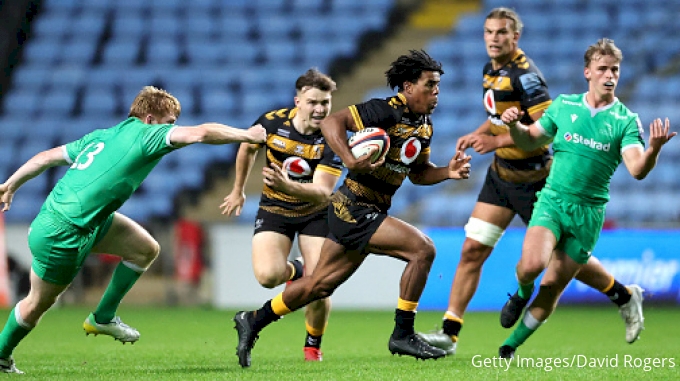
Worcester already is bound for the league next season and could be joined by Wasps.
With big clubs in the mix, revenue will hopefully follow and will bring back relegation and promotion, giving clubs like Ealing a shot at ascension. They are also one of only a few Championship teams that offer full-time professional contracts. That is something that needs to change.
Meanwhile, with fewer teams in the top flight, the broadcasting and commercial revenue available to each club would increase.
“The clear intention there is that we'll be able to drive more value through less volume – and you'll have better quality volume that will drive better quality value as well,” Sweeney said. “I want to end the myth that we're anti-Championship or the second tier. I can understand why the myth's developed, but the endless funding into the previous model was not the answer.”
For now, fans will have to wait.
The RFU has yet to release a concrete plan for the future, and any changes probably will not take shape before the start of the 2024-2025 season.
Written by Stefan Frost