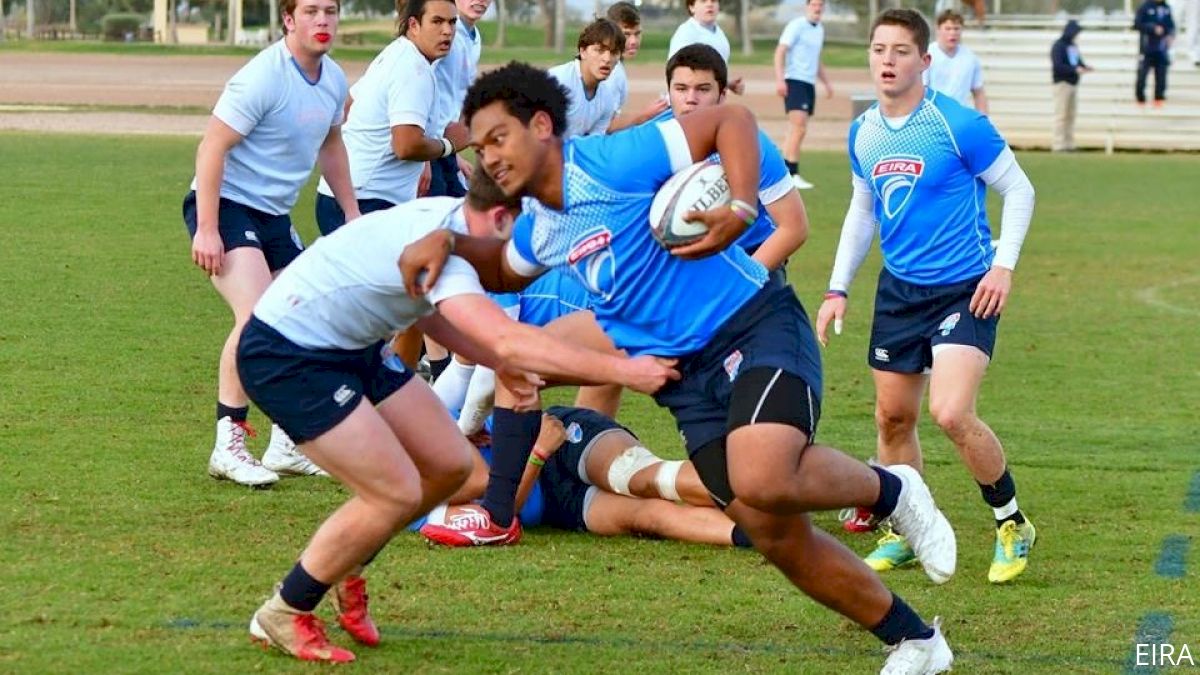
This past winter Eagle Impact Rugby Academy and USA Rugby held two elite camps for boys, camps that accepted over 300 top players into high-performance coaching environments.
FloRugby already checked in with players as the USA Rugby HS and Junior All American camps, so we decided also to speak with EIRA founder Robin Reid about the fact that 334 players were at elite-level camps at the same time, and what that means for the game.
This is what Reid had to say:
Huge numbers at camps
Between Christmas and New Year I was sitting and reflecting. This was the first year since 2010 that I hadn’t been at a winter camp, so I had the pleasure of sitting at home and watching the stuff that came out of both winter camps; it gave me time to kind of reflect.
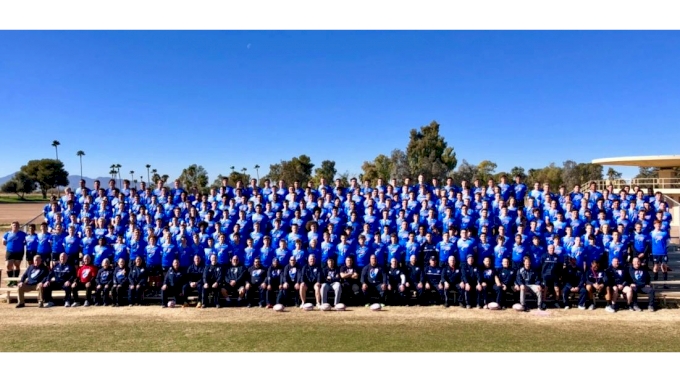
The EIRA winter camp had 252 players and 30 coaches and support staff and at the same time there were two High School All American teams and one rising Under 20 All America team in Chula Vista, with probably 80-90 players, so between the two there were about 330 players at a high-performance level and close to 50 top coaches in Winter Camp between Christmas and New Year this year.
And I thought back to 2010-2011 when we started sponsoring the High School All Americans, where we had something like 30 to 35 players - that’s about a ten-fold increase, and that was kind of the point that made me say 'wow!'
Full List 334 Elite-Level Camp Attendees
Could this dilute the talent level at both camps?
You asked about whether that dilutes the talent base. I look at the evidence. This is the first time we’ve had High School All American camps at the same time as the EIRA camp and the standard of rugby at the EIRA camp was as high as it’s ever been, notwithstanding the fact that a large number of players who were invited to the EIRA Winter camp were released to go to the All American camps.
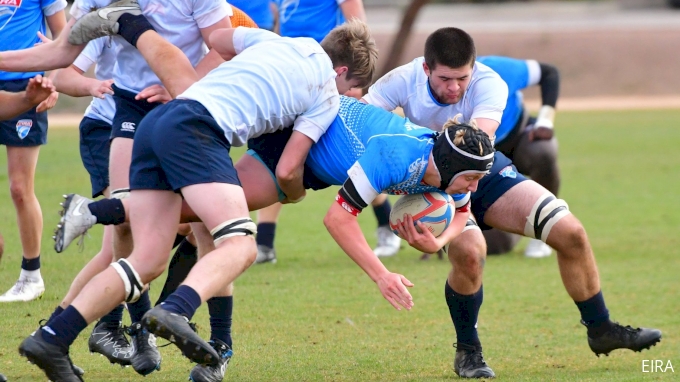
So while dilution is a thing we have looked at as a possibility, we continue to get new numbers as the standard of rugby in the country improves, and as our reach and our selection improves. For example, we just started in Connecticut and Massachusetts and at training camps I think there were like an additional 8-10 players that really should have been on camp, and will be this coming year.
What's the number where dilution might set in?
You can’t aim at a number and just flood it, but if you select correctly ... our starting frame of reference is: select the players who meet what we assess to be the performance standard and then you end up with whatever number you end up at.
You never want to chase the numbers. You’ve got the chase the quality, and the wonderful part is the numbers are taking care of themselves. The growth is there and the quality is what is pushing the numbers up. In fact at the EIRA Winter Camp, logistics was the limiting factor.
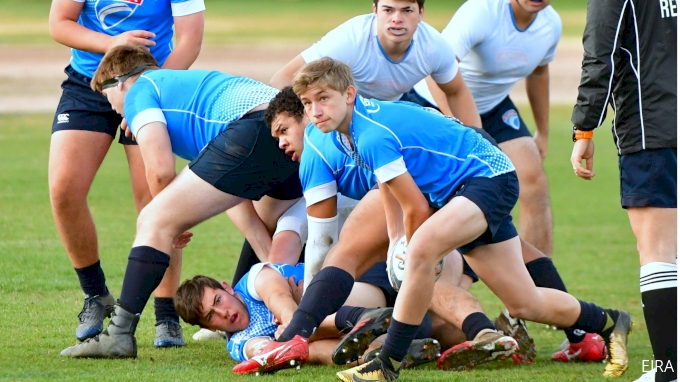
Instead of talking about hoping to keep the standard from dropping—is the standard rising?
So there are several factors around this that I think are stunningly important.
1) The group we had in 2010-2011 was a pretty special group, with players like Titi [Lamositele], Ben Cima, Michael Reid, Calvin Whiting and a number of other guys who are now playing professionally. They were good, but if you look at the quality, at the level that we’re playing at now, at both the EIRA camp, and particularly at the High School All American camp, the quality has gone up. So if you look at high-performance age-grade rugby in the US, it’s not just the numbers—there has been a significant increase in the standard of play as well.
Those 330 players, they’re at the level where they starting to feed into the top rugby-playing colleges, and into professional rugby. I just got really, really excited.
2) One of the things that excited me probably even more than the quality and the raw numbers is the fact that at the EIRA Winter Camp this year we had age groups that ranged from birth year 2000 to 2006, a span of seven years. The youngest player at camp was a 12-year-old, and he is a really good player. From the time Salty Thompson and I started working together, when we started sponsoring the All Americans, one of the things we always wanted to do was bring the ages lower each year and it's really pleasing to see this coming to pass.
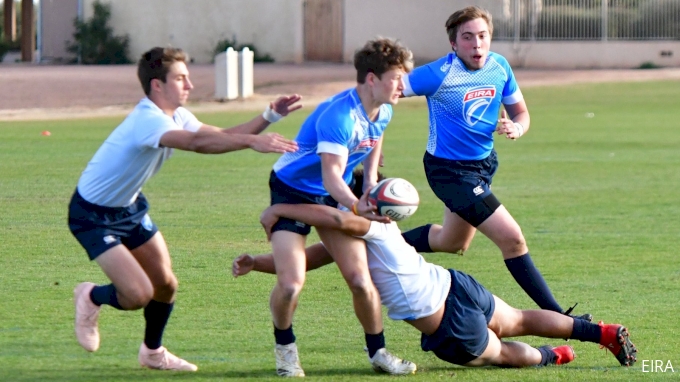
Can you imagine a 12-year-old kid participating at this high-performance level? They will be able to work with those kids for six years, before they go on to Scott Bracken’s Under 20s group. It bodes well for our rugby and I find it incredibly exciting.
3) We in rugby often kind of just look at where we are in rugby in the US, and often there’s a lot of doom and gloom, and sometimes quite rightly so. We’ve had our challenges at the national office, and with structures and finances etc, but actually those challenges, I think, are in the process of resolving themselves for the better due to a lot of hard work by a number dedicated people.
Not only players, but coaches are in camp
One of the big developments that EIRA started in late 2017, early 2018, was coach development, coaching coaches. It started with mainly our own coaches, a mindset that all of our coaches have to be consistent, they have to be coaching the same thing and we have to get all of our coaches coaching to a certain level.
It’s one of the things that Sean O’Leary and Brendan Keane have been spearheading and it’s been successful. And now we’re getting a lot of people from outside asking us to come and do the same thing for them. There's a demand and need for coach education that compliments USAR and their certification program.
Probably our real strength is in our coaches, in fact the true heroes in the EIRA success story are not Salty Thompson, Brendan Keene or Robin Reid, the real heroes are the 70-odd coaches around the country who are EIRA coaches who give their time free because of passion, because of love of what they do, and they include some of the best coaches in the country, widely recognized as being among the best in the country and many of them are and/or have been coaches of professional teams.
We're talking boys rugby, now how about girls?
We started getting into girls rugby in 2017-2018, which was new for us because EIRA grew out of the Boys High School All American program. This will grow in the coming year and we will be looking to offer skill development and team opportunities if the demand is there.
EIRA is huge because it's ambitious
EIRA is the biggest academy in the US, in fact the Irish coaches we met with on tour are of the opinion that EIRA is the largest in the world. When we were in Ireland in July, Salty and I were talking to them about who and what EIRA is and mentioned that we are probably the largest rugby academy in America and the fact that we had some 300 rugby players on rugby tours in the summer.
They said: “you’re not the biggest in America, you’re the biggest in the world.” We both kind of sat back and said: “What are you talking about?”
It’s really not something we had thought about. Their thoughts were that they couldn’t think of any academy in the world who could come close to taking 300 age-grade rugby players on rugby tours anywhere, one or two teams, three teams maybe, but not eight or ten. This coming year we will take U15s, U16s, U17s, and U18s to Canada (BC and Ontario), Ireland, and return to Argentina with a U18-19 squad.
EIRA isn't the only academy out there
If you look at the age grade rugby scene in the US there are a number of really good academies and there are a number of them that we work very well with, like Mike Cressler [Utah Lions Academy] and 2018 was the second year we made a combined team, an NAI team, that went to Dubai and won.
So the rugby academy scene in the US is starting to look quite exciting. There have been some that come and go and some that are not so good, but together with USA Rugby we’ve drawn up a fairly comprehensive benchmark, a set of standards, which has been approved but USA Rugby is yet to adopt, and I suspect Alex Magleby’s change in position, and the fact that we don’t have someone appointed in his place as yet, have probably held that up but that’s a really good step forward. It sets up—if you want to be a serious academy in this country here’s an outline of what you should meet or exceed and they are good sensible, solid things.
With a lot of the guys we work very well together because there is a common aim to improve, a common passion and we’re more than willing to work together and help anyone, whatever they want to do we’ll help them do something.
That’s the thing about EIRA, it’s not something we’ll impose on an area. The EIRA Regional Academies are always a cooperation between EIRA, players, coaches and clubs in that area. We scout them, help train them, and give them high level international and local touring opportunities. Our goal is to assist players and coaches get better and provide opportunities to achieve.
Summing up
So, all-in-all, I got really excited about where we are in rugby and about the future. We had a great year with the national teams and the MLR last year and that looks like continuing, and we seem to be getting the country’s rugby governing body to a much better place, and we have a great number of quality young player pushing up into what is increasingly becoming and ordered and positive framework.
For us at EIRA I am particularly excited about a number of things:
- We’ve got more and more people recognizing the successes we have achieved and approaching us wanting to be involved both in the US and internationally.
- We're adding girls rugby. This will be a huge growth area in numbers and in quality
- The significant increase in numbers of player without diluting quality
- The fact that we’re working with younger players and therefore have a longer period to help develop them
- The last thing, which I haven’t mentioned, which will be crucial to our growth, is that about five months ago we were approached by a rugby passionate man who’s a financial guru and he’s helped with arranging a financial structure to fund EIRA.
This is currently being developed and we expect to launch this towards the end of the first quarter. This is very important because there are inevitably some young players whose family circumstances are such that they can’t fund all the things they are invited to do. I don’t think we’ve ever turned somebody away for financial reasons, we generally get them to go to their community, go to their church, wash cars, do something—it's important for them to have skin in the game, but at the end of the day, once they’ve raised what they can, we try to make the rest happen.
So all in all I think this is really an exciting time for rugby in the US. A lot of hard work by a lot of dedicated and passionate people over a number of years is starting to bear fruit.