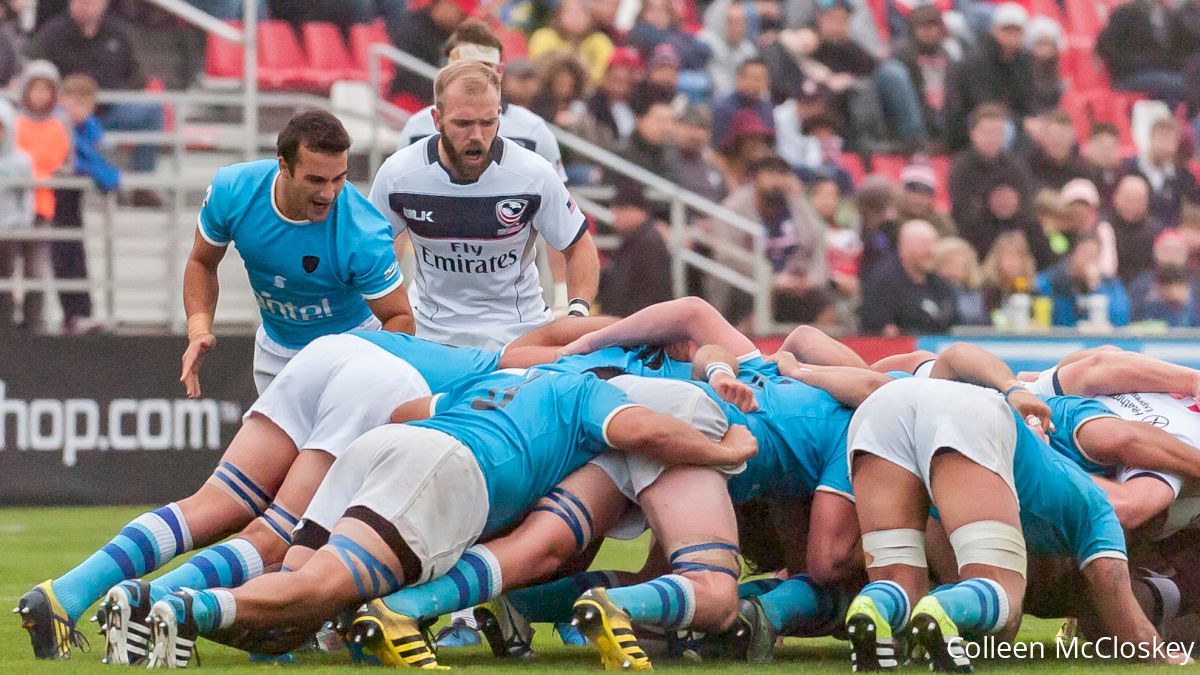
After opening with a clash between Canada and Uruguay last weekend, the first round of the Americas Rugby Championship continues this Saturday with Chile hosting Brazil in Santiago and the USA welcoming Argentina XV to Carson, California.
Here are five things to look at as the competition enters its second weekend.
Uruguay's Early Start
Uruguay defeated Canada 38-29 in Vancouver last Saturday to open the ARC. The game was also the first of a two-game Rugby World Cup qualifier series. The second game of that series is this weekend in Montevideo. Why was the first game chosen to be an ARC league game? Three reasons:
1) Uruguay has normally played the home game of the two-game series first. That's what happened in 2006 and 2010. So it was Uruguay's turn to play the second game at home, but the ARC schedule had Uruguay playing Canada in Canada.
2) It makes sense to have the first game be the ARC game because you want the final qualifier — the game that decides World Cup qualification — to be a standalone.
3) It maintains the integrity of the ARC. What if the second game is a runaway? Do you want the losing team to run on the subs? No, you want every second to count.
La Web Ellis Cup en Playa Ramírez. El #TrophyTour continúa en la previa al partido de este sábado en el Estadio Charrúa #VamosTeros #OtraCelesteAlMundial
— U.R.U. (@RugbyUruguay) February 1, 2018
? @frankiedeges pic.twitter.com/AcGt9nureq
Canada In Trouble?
Uruguay won that game in part because Canada is falling off tackles at key moments. That's a shocker. Canada may be a lot of things, but a team that tackles poorly is not one of them.
Well, the Canadians are now, and they are in real trouble as they visit Montevideo for the World Cup qualifier.
Break The Tie
The USA and Argentina XV have tied since 2016 — 35-35 in the 2016 ARC opener and 27-27 in the final game last year. Each time, the Eagles have been the better team in the rucks and in playing a structured, open-field attack. Argentina has been stronger in the scrum, in goalkicking, and in the counter-attack.
But the USA is improving its goalkicking and could be a more settled side this time around. It's time this matchup becomes a victory for the USA.
Last-Place Clash
Brazil and Chile are actually talented teams, so it's a little harsh to say that one of them is destined to finish last. We're not that impressed with Canada, and this could be a very bad season for the Maple Leafs if they don't turn it around really quick. However, it's tough to imagine Chile or Brazil getting more than one victory out of this season.
Having said that, you underestimate these two at your peril. Brazil showed in 2016 that with a vocal home crowd, the right circumstances, and some excellent goalkicking (which both teams have), it can pull off an upset.
Last year, though, Chile had problems, losing all five matches and scoring five tries in the process. Brazil, meanwhile, has secured home wins over the USA (in 2016) and Canada (in 2017).
USA's Keys vs. Argentina
Two things matter more than anything else: scrums and ball security in contact.
That's basically one thing, because both come down to scrums more than anything. The USA cannot have a scrum that is disintegrating and backpedaling. Moving backward and not super strong? That's OK — as long as the ball comes out the USA's end on its put-in and as long as there isn't a litany of penalties.
To mitigate that, the Eagles need to have fewer scrums, and the best way to do so is to avoid handling errors. Mostly this means dropping the ball when you're tackled or being so aggressive in the rucks that you fumble the ball. Sometime it's a lineout throw problem (call that a thing that matters 2B), but really it's all about players not losing possession in contact. Do that, and you win.
You don't have to be fancy and your goalkicker can miss some early ones. But if the USA can work phase upon phase and force the other team to defend, then the Eagles can open up gaps and score tries.