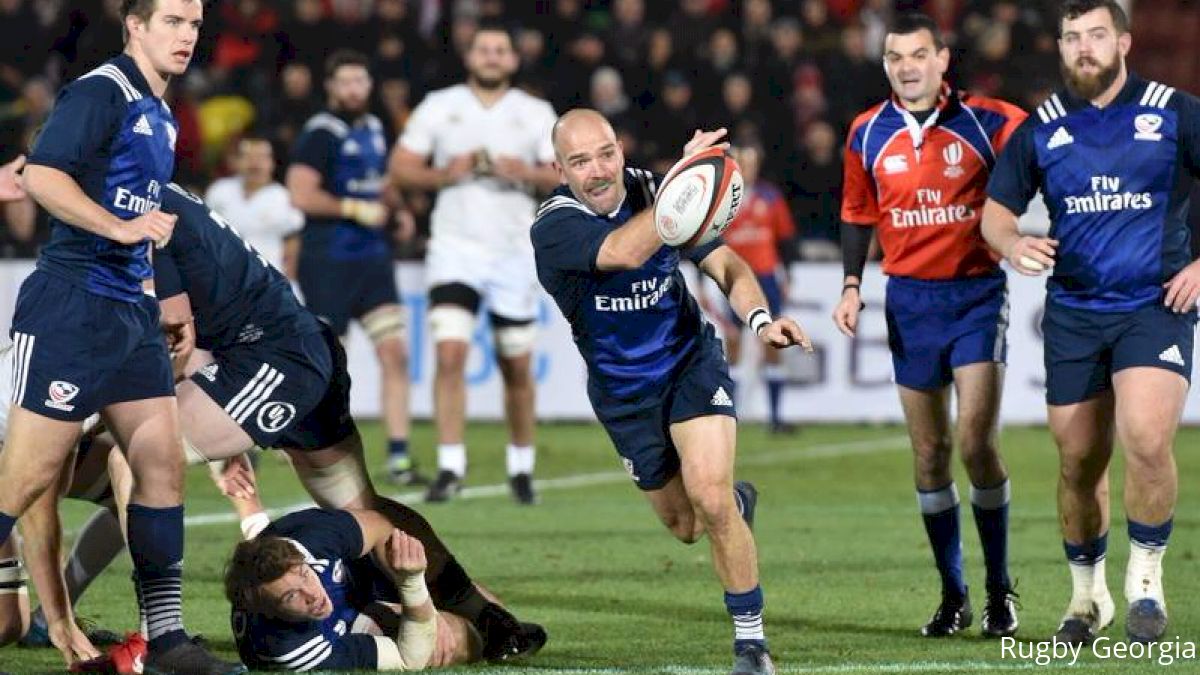
The Eagles did not move the needle in the World Rugby rankings these last two weeks, and really you wouldn't expect them to after splitting a pair of internationals against No. 26 Germany and No. 12 Georgia.
But in the end, the USA team did exceed expectations, almost beating a really strong Georgia team in Tbilisi on Saturday. Georgia, in turn, had recently come very close to trying Wales. So losing 21-20 to the Georgians wasn't so bad for the Eagles.
Although...
It could have been better. The USA could have, and really should have, won its final international of the year. Let's look at why that didn't come to fruition and what the Eagles could have done differently in the matchup.

Referee Calls
Actually referee Pierre Brousset did mostly fine and didn't make any calls that were egregious. He did give Georgia a penalty try after one released binding on a scrum, which is enormously harsh and a call you doubt you'd see if the defending team was a Tier I nation.
He called one "not straight" in a USA lineout that was just flat silly, and while he penalized Georgia for high tackles, he missed several, too.
Of all the calls, the "not straight" was perhaps the worst, because it denied the USA a legitimate scoring opportunity midway through the second half.
Do We Kick Because We're Bored?
What's with all the kicking? It seemed planned, and it was odd. AJ MacGinty is a world-class running flyhalf. Yes, he can kick effectively, but he makes offenses sing. Instead, after a few phases, MacGinty would often kick, opting for a grubber or a long wiper kick.
In one sequence in the second half, the Eagles ran six phases, MacGinty grubbered, and Ryan Matyas regathered the ball. Six phases later, MacGinty grubbered again. Maybe we've been watching too much rugby league during the Rugby League World Cup, but it seemed like a league approach to us.
The result was Georgia got the ball and started to come back the other way. When they ran the phases, the Eagles looked pretty dangerous. In fact, the Bryce Campbell try near the end of the game came after nine phases. Why didn't the USA kick that time? MacGinty was caught in the ruck a couple of times and wasn't in position to kick.

Impatience Kills
If the Eagles were patient in getting Campbell his try, they were impatient at other times. The key period was when they were up two players thanks to yellow cards against Georgia. The USA had an attacking lineout but seemed a little complacent in the maul after scoring two tries that way. They got shoved back and then seemed to rush to get themselves on the front foot again, giving up a dumb penalty as a result.
On defense, the USA players were, for the most part, quite good. Samu Manoa was a beast and Marcel Brache also impressed.
But a few times the line seemed out of synch, and several players missed tackles, possibly because someone was up too quickly.
Penalties Produce Georgian Tries
By our count, the USA committed 10 penalties and Georgia was penalized nine times. Georgia got pinged with more yellow cards but deserved probably one more. Both sets of coaches probably told their players that they gave away too many points with silly penalties.
Certainly only one of Georgia's three tries came from the Lelos putting together a long sequence of play.
Still About The Scrums
The Eagles scrum wasn't so bad. Yes, it gave away a penalty try, but that was harsh. It also rescued a try-scoring opportunity for Georgia when Joe Taufete'e got a strike against the head. (It was very interesting to see scrumhalf Shaun Davies urge Tuefete'e to try for the strike — he must have seen something, and it worked.)

Overall, the USA had four scrum put-ins, winning three fairly cleanly and getting a free kick in the other. Georgia had seven scrums, with only one (the first one) ending up as a clean win for possession. One was lost to the USA, and the rest ended up as penalties for the Lelos.
So Georgia won the scrum battle but not so much that the Eagles couldn't launch for their own scrum.
In addition, you have to love the USA's attitude. From the beginning of the game, the players clearly knew the scrum was important. The Eagles locks could be seen encouraging props, and backs — Marcel Brache especially — could be seen encouraging all forwards. They should keep doing that.

The Upshot
This USA squad isn’t a bad team. The players, overall, know what they’re about, and despite navigating some coaching changes, they will be fine. The team didn’t look particularly unsettled as a unit, and players such as John Quill, Samu Manoa, and Marcel Brache seemed to slot in without looking like they’ve been absent for a while.
Occasionally, they seem out of defensive shape. The kicking undercut the fact that the Eagles are running the phases pretty well, and the scrum still needs work. But with the ball in hand, the USA national team can do enough damage to win rugby games. As many as 12 games in 2018 will show us if the Eagles can get there.