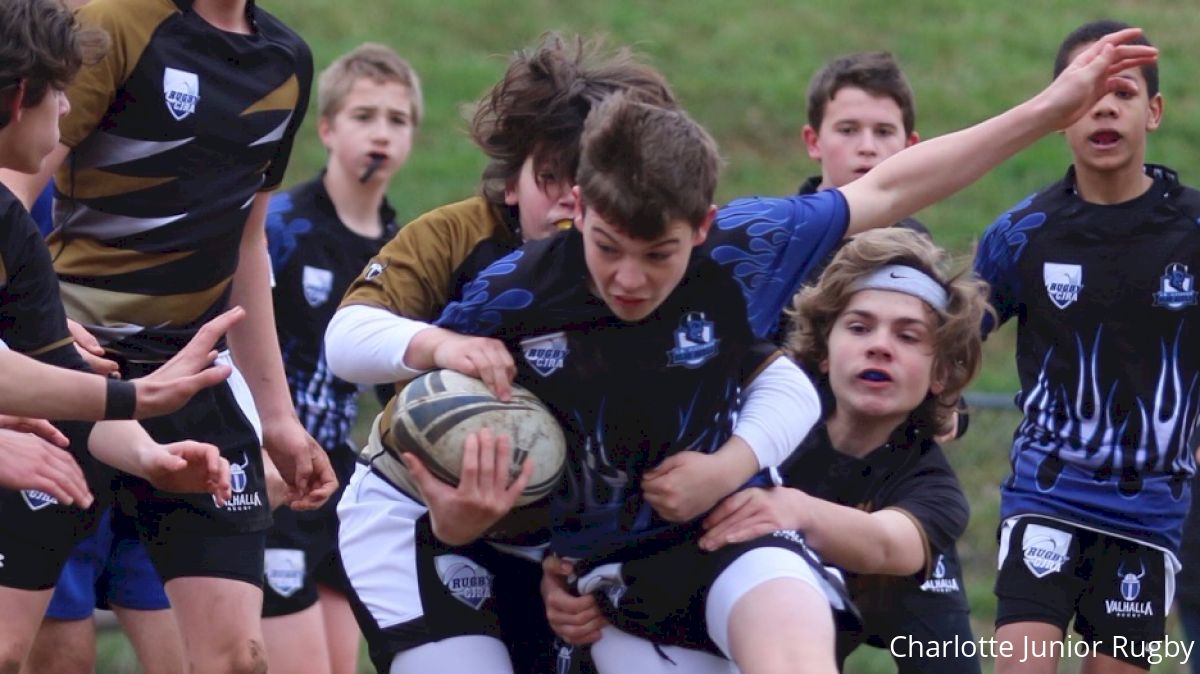
A debate raged within U.S. rugby circles last year about a plan to delay introduction of full contact to young rugby players.
That debate exploded thanks to some publicity by this writer and a pile of opinions (what else is new?) from the rugby public. Although there’s news coming -- more on that in a moment -- the heated discussion about contact at the youth level has extended past the borders of the United States.

In Great Britain, there’s talk of not teaching tackling and scrums to younger rugby players until they are older. On the face of it, such a suggestion seems counterintuitive -- how do you coach safe contact if you’re not allowed to? (Change the word “contact” with “sex” or “interaction with strangers” or “street-crossing” and you see the point.)
Well, this debate made it onto TV and the video is below.
Invited were former England international Jeff Probyn and Eric Anderson, who was introduced as professor of sport at Winchester University. That was somewhat misleading, but, anyway, watch the video.
The first big takeaway from this is the idea that tackling and scrums should not be taught to young athletes by PE teachers who have not been trained in rugby.
This makes all kinds of sense.
The assertion, also, that many young athletes in the UK get introduced to rugby by coaches who don’t know a lot about the game is probably true. I know in my own experience I had some really, really outstanding coaches with impressive rugby pedigrees, and other coaches who clearly weren’t equipped to coach a team.
The second big takeaway from this discussion is the idea that schools shouldn’t be teaching contact (again, the not-trained thing) to young athletes, and that should be left up to proper rugby clubs.
This, too, makes sense. That is where the experts are.
However, why is it that Anderson had to go about this behaving like such an unmitigated asshat? I heard his accent and prayed he was Canadian so he wouldn’t fit the ugly American stereotype. No such luck.
But I did discover that while Anderson lauded his qualifications over Probyn, he misrepresented himself. He’s not a professor of sport, like he’s an expert on how people teach the play sports. No, he’s a professor of sport, masculinities, and sexualities. Basically his area of study is how much and how often male sporting teammates want to get with each other.
From his bio: He is the leading academic expert on gay men in sport, and the architect of Inclusive Masculinity Theory, which was generated from his research showing that decreased homophobia leads to a softening of heterosexual masculinities.
He lists his areas of expertise as:
The Social Problem of Collision Trauma in Contact Sports; Sociology of sport, examining gender and sexualities; Sociology of Masculinities, in either education or among youth; Homophobia in sport or education; Monogamy and cheating among athletes and non-athletes; Bisexuality; Coaching distance runners
Now, I am sure these are valuable areas of study -- the experience of gay athletes, both out and not out, is definitely something worth talking about -- and I am sure collision trauma has its social ramifications, but what thing in all of these highly important areas of study makes him an expert to talk about when a kid should learn to tackle?
It’s like they looked around for the most obnoxious, high-handed, fuzzily academic derp-peddler to discuss this to …
Oh, I get it, they wanted to disqualify his position. OK, that was probably successful.
In many respects, Anderson is not wrong. He’s rude and condescending, but that doesn’t make him wrong.
At the same time, the introduction to the piece says something fuzzy like “this follows medical research that says …” Watch out when you see that. Calling it “medical research” doesn’t mean they used a control group or that the medical professionals involved knew what they were doing or didn’t have an agenda. The “research” suggests tackling and scrummaging leads to more dementia. Well, sure, if you track people who tackle a lot, and people who don’t, you’re going to run into a few people (even if everyone tackles perfectly) who develop a brain injury, and that can increase the incidence of long-term concussion effects in that group.
That’s like saying yachting near Somalia leads to bleeding problems, when of course you’re just more likely to be shot by pirates.
Having said that, Anderson says in the video the call is to ban tackling in PE rugby in schools, and that might be a smart move.
Rugby in 2017 is different than rugby in 1977, when I first officially learned to tackle. The kids are generally bigger, and the dichotomy of sizes is larger -- there are still scrawny kids who want to play, while the large kids get larger.
While the basics of safe tackling are pretty much unchanged, there is a strong argument that proper training helps guide young players into contact.
So this is a debate in rugby in the USA. While football is under serious heat for the nature of the game leading to head trauma (that is, helmets, combined with poor coaching, make it worse), rugby has tried to hold itself up as the better, safer option. That’s a good move for rugby, and I believe, as many do, that tackle rugby is still safer than tackle football.

(I also believe tackle rugby is, in the long term, safer than soccer, a sport that requires you to learn to hit a ball traveling at a high rate of speed with your head.)
But that doesn’t mean rugby has it all figured out. If we hold up rugby as the concussion panacea, we better be able to back it up.
So now USA Rugby has been working on introduction to contact guidelines. You will see them rolled out for public comment soon. I have seen them, and they are much, much more reasonable than the suggested guidelines we all saw a year ago. The new ideas are a graduated introduction to tackling and other aspects of contact (rucks, mauls, scrums, lifting in the lineout) from around fourth grade through to seventh grade. There’s wiggle room -- if you don’t want to introduce tackling in fourth grade, don’t. And “introduce” can mean a lot of things but should focus on body position and technique before collisions.
All of that is coming. The American rugby public is going to have a chance to voice opinions. But it’s coming, and it has to be codified. While football is still getting it wrong in a lot of ways (such as helmets and pads for little kids) and soccer doesn’t even know what has been common understanding for generations -- longtime soccer players get punch drunk (basically CTE) -- rugby can still lead the way.
Just keep that guy from Winchester out of it.