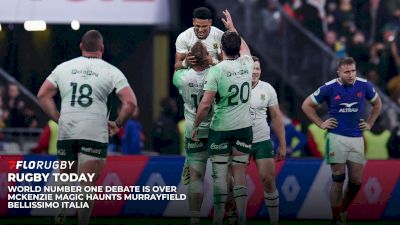
The third weekend of the Autumn Nations Series arrives at a moment when uncertainty hangs over many of the major contenders, and when several of the emerging nations sense that opportunity is closer than ever.
It is a round framed less by spectacle and more by consequence, not so much a collection of isolated fixtures, as a series of examinations that will reveal who genuinely is building toward something meaningful and who merely has drifted through the opening stages of November.
- Subscribe To FloRugby To Watch Top 14, URC, and PREM Rugby All Season Long
- Autumn Nations Rugby Schedule: All Blacks Take On Twickenham In Round 3
- Latest World Rugby Rankings: Argentina Opens Gap, Springboks Hold Control
- The 100 Best Rugby Players In The World: The Full List
South Africa travels to Turin with the unmistakable authority of a side that has learned how to manage these windows without surrendering competitive edge or developmental value.
England hosts New Zealand at Twickenham with a level of quiet confidence unusual for a side still trying to define its long-term identity.
France must restore order in Bordeaux after the heaviest blow to its national psyche since the night it was bundled out of the World Cup.
Ireland and Australia meet in Dublin in what feels like a test shaped as much by the emotional weight of recent months as by tactical detail.
Scotland and Argentina close the weekend with a fixture that may, in time, be remembered as the most closely matched of the lot.
There are clearer narratives this weekend than at any other point in the window. What follows is the landscape each team walks into, and the implications each must manage.
Italy’s Emerging Structure Meets The Ultimate Benchmark
There is a growing sense of conviction around Italy that can be seen in the team's performances throughout the year, most notably during the July meeting with South Africa and again last week against Australia.
The Italians have been promising before, but this iteration under Gonzalo Quesada carries a different thread. It is a team with a more defined spine, a clearer understanding of its strengths and a willingness to play long sequences with accuracy rather than desperation.
The comeback victory over Australia did not feel accidental. Italy absorbed pressure, adapted in real time and showed enough presence in the key contact areas to prevent the match from becoming an uphill defensive exercise.
Quesada has instilled a level of composure that has been missing for much of the past decade. That enhanced resilience complements the natural attacking instincts that long have been associated with players like Ange Capuozzo and Monty Ioane.
Louis Lynagh now adds a third point of athletic quality in the back three, providing range, work rate and an instinct for inserting himself as a genuine second-wave runner.
What has changed most in Italy is the midfield.
Ignacio Brex has become the heartbeat of the defensive structure, an organizer who aligns the line and ensures that Italy does not fracture under fast ball.
Alongside him, Tommaso Menoncello is blossoming into a center of real stature, a player capable of carrying the ball with power, defending with width and offering immediate impact on counterattacks.
This pairing gives Italy a level of control in the middle third that very few European sides outside the traditional giants can replicate.
The largest question, as always, centers on the tight five.
Italy can play phase after phase, but if the Italians are unable to hold the scrum long enough, or slow the Springboks maul consistently, they will face a constant battle for territory and rhythm.
Quesada’s decision to opt for a 6-2 bench split speaks directly to this concern. It prepares Italy for a match played at a level of physical intensity that is non-negotiable against South Africa.
David Odiase and Ross Vintcent offer back-row versatility reminiscent of the multipurpose roles that Kwagga Smith performs so well, which may allow Italy to chase certain periods of the match with greater freedom.
Staying within 10 points feels like a reasonable measure of progress.
South Africa does not give up cheap territory and rarely surrenders structural control. If Italy can hold possession for long spells and deny the Springboks their preferred line-out platforms, they will continue the upward trajectory that has defined their year.
South Africa’s Selection Evolution Continues To Reveal Rassie Erasmus’s Intent
South Africa arrives in Turin with a selection that reflects both confidence and purpose.
Rassie Erasmus has never built his teams around short-term thinking, and his choices for this match continue that theme with striking clarity.
The midfield pairing of Ethan Hooker and Canan Moodie has drawn attention because it represents a possible long-term combination, but the deeper significance lies in the structure that surrounds them.
Handre Pollard provides a steadying influence inside them, Damian Willemse manages the backfield behind them and the pack includes enough experience to ensure that neither young midfielder is exposed to uncontrollable moments.
The philosophy is not new to South Africa.
Erasmus has long preferred to introduce players alongside pillars of experience, allowing them to grow within a structured environment, rather than being forced to dominate immediately.
Zachary Porthen, Johan Grobbelaar and Boan Venter arrive with minimal combined caps, yet they pack down behind Franco Mostert and Jean Kleyn ,who bring nearly 100 tests between them across two nations.
Ben Jason Dixon will work in a back row led by Siya Kolisi and Marco van Staden, giving him the type of guidance that accelerates learning without removing responsibility.
South Africa’s bench reveals the rest.
It is heavy with experience, heavy with influence and heavy with the type of players who can shape a final quarter, almost regardless of the match’s earlier state.
Italy will need clarity, discipline and a strong field position to compete.
South Africa will feel no such pressure. Its systems are proven. Its continuity is unmatched.
England And New Zealand Renew A Rivalry Shaped By Contrast And Identity
Twickenham has hosted countless England versus New Zealand encounters that felt monumental, but this meeting carries unusual weight because of what both teams are trying to build beyond the scoreboard.
England, under Steve Borthwick, has become increasingly open about its intentions.
The team's structure is direct, methodical and unapologetically based around contestable kicking and tightly linked defensive coverage.
George Ford returns as the conductor, Freddie Steward anchors the backfield and the wing pairing of Tom Roebuck and Immanuel Feyi Waboso is built for the aerial battle, rather than touchline fireworks.
What England has added this month is a more nuanced approach to the second phase of the kicking contest.
The back row is running exceptional trail lines behind the back three when they are competing for the ball in the air, but positions itself to strike the moment the ball is slapped down, whether by friend or foe. It is a small but meaningful evolution, and the tries scored by Ben Earl and Henry Pollock against Australia illustrated how effectively England has embraced this approach.
The England bench again operates as an extension of the team's starting identity.
Chandler Cunningham South mirrors the versatility of Alex Coles. Tom Curry takes the role of defensive enforcer from Sam Underhill or Guy Pepper. Marcus Smith covers both fly-half and fullback, offering a change of pace without abandoning the overarching philosophy.
Whether this will succeed against New Zealand is uncertain.
The All Blacks are far more capable under the high ball than Australia, and they will not allow England the same degree of territory control.
For Borthwick’s side to impose themselves, they must win the early aerial exchanges and maintain the discipline required to defend the middle third without inviting momentum.
New Zealand arrives as a team whose November has been defined by contrast.
The All Blacks have played rugby of breathtaking quality in 10-minute spells against both Ireland and Scotland, yet they have drifted out of matches for extended periods.
Their ability to rediscover intensity in the closing stages remains their greatest strength, but at some point, they must show the capacity to deliver 80 minutes of consistent engagement.
This match will hinge on whether New Zealand accepts the invitation to hold the ball for longer phases, or whether the All Blacks remain attached to the more conservative, kick-dominated template of recent weeks.
England will give them possession in certain areas of the field. The question is whether Scott Robertson trusts his side to build pressure through continuity, rather than territory alone.
Wales Seek Clarity, While Japan Searches For Momentum
Wales remains a team caught between past strengths and future ambition.
A loss to Argentina was stark, not simply because of the scoreline, but because of the areas in which they were repeatedly exposed.
The guard defense around the fringes was too slow to reset, spacing across the line was inconsistent and the width coverage lacked timing.
Against a Japanese side that thrives when defenses hesitate for even a moment, these lapses become significant vulnerabilities.
Steve Tandy will know that Wales does not need to play expansively in this match. His team needs to play with rhythm, control and patience.
Their physical edge, while not overwhelming, should be sufficient to grind down Japan, provided Wales resists the temptation to chase width too early.
Wales still possesses the set-piece and breakdown strength to turn this match into a forward-oriented affair, and doing so may be the clearest path to success.
Japan will look for the opposite.
Japan's attacking shape remains sharp when its are allowed to play at tempo, and the team's ability to generate movement across the back line has troubled every team they have faced this month.
If Japan can jump ahead on the scoreboard and push Wales into a chasing posture, the match will tilt dramatically. Wales does not respond well when forced into improvisation, while Japan becomes far more dangerous when the opponent’s structure begins to fray.
France Faces A Pivotal Test Of Leadership And Identity In Bordeaux
There is no disguising the significance of this match for France.
The loss to South Africa last week was not simply a heavy loss, it was a direct challenge to France's internal narrative.
For much of the past four years, France has been presented as a side on the cusp of sustained ascendancy, but the performance in Paris shattered the illusion that the World Cup quarterfinal defeat was primarily about officiating or misfortune.
South Africa exposed France in every area where they historically have felt strongest, from power through the middle to precision at the edges.
Fabian Galthie finds himself under increasing scrutiny.
His decision to move away from Gregory Alldritt as captain already raised eyebrows, and the team’s response in his absence was disjointed in structure and temperament.
Alldritt returns now with the responsibility of restoring tempo, controlling momentum and giving France the type of forward presence it lacked against South Africa.
Fiji represents a more awkward opponent than its status might suggest.
Fiji was impressive in several key areas against England, most notably at the set-piece, and has become increasingly well-organized under pressure.
Fiji's forwards carry with depth, the team's defensive spacing is improving and its ability to punish turnovers remains among the best in the world. If Fiji slows France’s recycling and forces longer sequences around the ruck, the match may become uncomfortable for the home side.
France should win but cannot afford to stumble again. Another performance lacking clarity would shift the national conversation from disappointment to genuine concern.
Ireland Seeks Structure And Stability Against An Australian Side Searching For Emotional Energy
The meeting between Ireland and Australia at the Aviva Stadium carries a sense of significance that far exceeds the immediate standings.
Ireland has not been fluent this month. The line-out has been erratic, the contestable kicking has been inconsistently chased and the attacking tempo has lacked the fluidity that once made Ireland the most structured side in the Six Nations. Yet, the selection choices for this match suggest a clear attempt to recalibrate, rather than rebuild.
Sam Prendergast’s continued inclusion ahead of Jack Crowley is less an indictment of the incumbent than a planned distribution of responsibility.
Ireland clearly wants Prendergast tested in meaningful minutes without burdening him with the expectation of defining the November narrative.
Caelan Doris moves to the openside, where his athletic range and defensive presence can support a pack that has lacked speed between the ruck and the edge.
Brian Gleeson’s long-term future at No. 8 is evident, but for this match, Jack Conan resumes the role of direct ball carrier and primary collision manager.
The Irish midfield raises questions.
Stuart McCloskey provides calm distribution and robust defense, but Robbie Henshaw’s form remains inconsistent, and his lack of pace has become more pronounced.
Mack Hansen’s deployment at fullback is an overdue experiment that could give Ireland a second distributor with natural counterattacking instinct, and his presence may help Prendergast control the first two phases after receiving aerial returns.
Ireland’s bench is perhaps the strongest indicator of intent.
- Paddy Farrell starts to give Andrew Porter a focused, high-impact role.
- Ronan Kelleher receives trust in an area that has struggled throughout the window.
- Thomas Clarkson and Cian Prendergast add ballast and athleticism.
- Nick Timoney offers finishing pace and opportunistic threat.
Australia arrives wounded in body and spirit.
The Wallabies' season has been fractured by injury, by inconsistency and by uncertainty surrounding Joe Schmidt’s future.
The loss to Italy felt like a psychological blow as much as a technical one, yet the return of Len Ikitau restores their attacking shape.
Ikitau is the fulcrum around which the back line is constructed, the player who brings alignment, direction and quality to the wider channels. With him, Joseph Suaalii regains the type of launching platform that can change the character of a match.
Australia’s challenge remains depth.
The Wallabies cannot fade late against an Irish bench that is built to grow into the contest. If they are to win, they must generate scoreboard pressure early, slow Ireland’s line-out platform and expose the lack of pace in the Irish midfield before the substitutions arrive.
Scotland And Argentina Offer The Weekend’s Most Balanced Contest
The final match of the round may well be the most compelling.
Scotland remains a side with a ceiling that is high, but the team's reliability under pressure is not yet consistent.
Scotland's performance against New Zealand swung from composed brilliance to structural fragility, and the frustration of watching a 17-point lead evaporate will linger longer than the effort required to chase that margin in the first place.
This is a test of resolve as much as technique.
Scotland long has believed it can stand alongside the second tier of global contenders, but to do so, the Scots must win matches like this one, where the margins are narrow, the opponent is organized and the pressure is not external, but internal.
Argentina arrives with the momentum of a side comfortable with its identity.
The pack is one of the most formidable in the world, defined not simply by power, but by cohesion and clarity.
Under Felipe Contepomi, Los Pumas have evolved into a team capable of managing tempo, manipulating territory and imposing a systematic pressure that gradually wears down opponents.
Their victory over Wales demonstrated both ruthless potential and a capacity to correct lapses in real time.
This match will depend on whether Scotland can secure a stable platform.
If the scrum and line-out hold firm, Finn Russell can shape the contest with the accuracy and vision that have made him one of the most influential playmakers of the era. If they fracture, Argentina will roll through the middle third and turn the match into a physical examination Scotland cannot pass.
A Weekend That Will Reshape The Arc Of November
What unites these fixtures is the sense that each one carries a layer of narrative consequence.
Italy seeks validation against the world champions.
South Africa continues its slow, but deliberate, evolution under Rassie Erasmus.
England and New Zealand confront each other in a test that will reveal as much about style as it will about substance.
Wales and Japan chase direction.
France must restore belief.
Ireland and Australia face questions that have accumulated across a long year.
Scotland and Argentina meet as equals, rather than opposites.
The third week of the Autumn Nations Series almost always brings clarity. This year, it brings something more. It brings answers that several teams have spent the past month trying to avoid.
European Union Rugby Lives On FloSports And FloRugby
Rugby fans can stream every match from the Top 14, Gallagher Premiership and United Rugby Championship on FloRugby, along with the Investec Champions Cup and EPCR Challenge Cup, making the platform the U.S. home for the world’s biggest club competitions and the game’s top players.
How To Watch Rugby Matches In The United States On FloRugby
Professional club rugby in Europe all streams on FloRugby and the FloSports app in the United States. FloRugby and FloSports also are the U.S. home to:
- United Rugby Championship
- PREM Rugby
- Top 14
- Investec Champions Cup
- EPCR Challenge Cup
- Currie Cup
- Super Rugby
- And more
FloRugby also is home to match archives and match replays.