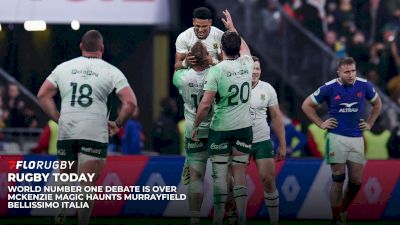
Irish rugby stands at a crossroads.
The standards the teams has set under Andy Farrell demand immediate course correction, not fire alarms or emotional overhaul.
The recent Autumn series confirmed two realities at once: Ireland remains a system team capable of winning, and the Irish no longer are a team with the athletic edge, timing or velocity to dictate terms against top-tier opposition without change.
That is the hard truth.
Australia is fast, unpredictable and desperate to build its own identity.
South Africa will drag Ireland into a physical minefield.
Against both, blunt force and precision will matter more than tempo, theory or tenure.
- Subscribe To FloRugby To Watch England A Vs. South Africa XV
- World Rugby Rankings: Where Things Stand Before The Autumn Nations Series
- The 100 Best Rugby Players In The World: The Full List
The short-term is obvious.
Fix the squad to handle the Wallabies and the Springboks in the next fortnight.
The long-term is bigger.
This squad must be rebuilt, reloaded, rewired and rearmed to arrive in Australia in 2027 feeling less like defending contenders and more like feared disruptors again. To do that, Ireland needs to reaccelerate the evolution it quietly paused in 2024.
The Immediate Fix: Front-Row Youth With Intent
Ireland’s bench recently has resembled a parachute more than an airstrike. It has slowed games, rather than changed them. This has to stop now.
The young trio of Gus McCarthy, Paddy McCarthy and Thomas Clarkson must become Ireland’s front-row finishers across the next two tests. Not future assets. Present weapons.
Finlay Bealham remains a premium tighthead, but he is 34, and impact at this level is now a youth sport.
Clarkson, 25, brings power, involvement and presence that energize a contest, rather than preserve it. That matters when the Springboks turn the final 25 minutes into a demolition derby and when Australia converts chaos into oxygen.
Gus McCarthy’s influence in stabilizing Ireland’s line-out against Japan was not a cameo; it was a signal flare. His throwing improved a long-term structural issue that Ronan Kelleher has battled for nearly two seasons.
Kelleher remains a destructive carrier and athlete, but at the international level, you cannot be a hooker who negotiates line-out chaos. You must end it. Secure set-piece is not a bonus; it is oxygen. McCarthy delivered it instantly.
Paddy McCarthy’s try and his ability to increase tempo, rather than reduce it, means Ireland finally can build a bench that accelerates moments, not diffuse them. This is the axis of the new-age test match: replacements must increase brutality or increase speed. Ideally, both.
Renewal In The Back Line: From Familiar To Functional
Ireland’s back line is experienced. That is not the same thing as explosive.
Robbie Henshaw, Bundee Aki and Garry Ringrose have delivered unforgettable rugby in green, but right now, the collective throttle sticks.
The midfield needs physicality that bends gain lines and offload options that distort defensive planning. Right now, Ireland’s midfield asks questions less effectively than it once did.
This is why Stuart McCloskey has to return to the center mix.
His carrying profile is unapologetically direct, his offloading windows are real and he creates secondary chaos, the most valuable currency in rugby.
Alongside him, Tom Farrell deserves continuity after showing attacking endeavor that suggested someone still has bandwidth to beat a defender, rather than negotiate one.
Farrell, at 32, does not carry the same mileage as Ireland’s incumbent options. He may not be the long-term answer, but he absolutely can be a short-term solution.
On the wings, Tommy O’Brien already has shown flashes of invention and timing. He needs patience now, not rotation.
On the other side, Ireland should recommit to Jacob Stockdale. His pace remains a threat, even though opposition scouting files admit it exists.
Yes, there are rough edges, but Ireland possesses too few players who force coaches to plan around them. Stockdale still is one of the few.
James Lowe offers craft, power and an educated left boot, but he cannot outrun elite wide defenders. Against Australia and South Africa, Ireland must threaten the edge at pace, or they will be smothered inside it.
At fullback, Jamie Osborne showed creative growth against Japan, particularly in distribution, but injury means the shirt must shift.
Mack Hansen has to return. He is a creator first, a chaos engine second - and Ireland needs both.
Longer-term, Osborne’s ceiling looks highest at 12, where his blend of kicking, handling and distribution resembles a prototype for Ireland’s next generation inside center.
At halfback, parameters must shift.
Against Australia, Craig Casey and Jack Crowley should start. Continuity breeds confidence, and these two need more of it together, not less.
Jamison Gibson Park should finish the game, not begin it. This changes Ireland from predictable referents to evolving pictures.
Ciaran Frawley must be retained as a bench multi-tool. His ability to cover 10, 12 and 15 is strategically priceless. Most importantly, he has an established habit of turning moments, not narrating them. Big occasions do not shrink him.
Then comes the most sensitive call of all. Sam Prendergast is not being benched; he is being protected.
Both Australia and South Africa will hunt his channel. Not tactically, emotionally. Putting him in the coach’s box, or on the periphery of a pressure environment, gives him a free postgraduate week in game management without public penalty. This protects confidence, reputation and long-term development.
Nobody wins if Prendergast becomes a public battleground, as has been the case in a handful of big tests over the past year.
Back Row 2.0: The New Torque Department
Ireland’s back row must evolve from a unit that works hard to a unit that overwhelms. This begins with a bold but correct switch: Caelan Doris moves to openside, Cian Prendergast starts at blindside and Jack Conan takes the No. 8 jersey.
The logic is linear.
Doris is Ireland’s best combative hybrid forward, and at No. 7, he becomes a turnover threat, a carrier, a link man and a pressure point.
Prendergast adds athletic chassis, defensive reach and set-piece options. Conan brings line break potential that Ireland currently lacks.
Ryan Baird’s positional discipline has wavered when starting. That is a mental processing issue, not a talent issue. His best rugby comes in compressed bursts, where instruction is binary and impact is measurable. The final 20 minutes is his habitat. Let him hunt there.
Nick Timoney must become part of the finishing blueprint. He is a power runner and multi-role defender who fits an abrasive, impact-focused 6-2 bench plan with McCarthy, Clarkson, Ahern, Baird and Timoney backed by Gibson Park and Frawley.
This profile can match Australia’s tempo, and more importantly, South Africa’s violence.
Long-Term Rebuild: The 2027 Roadmap
Ireland’s future argument frequently is framed through a lazy national narrative: a lack of depth. It is factually wrong. The depth is there; it simply needs to be commissioned, promoted and selected.
By Province, The Opportunity Is Enormous
Connacht under Stuart Lancaster is incubating test-caliber profiles.
Hugh Gavin, Matthew Devine, Sam Illo, Shayne Bolton and Sean Naughton represent athletic profiles. Ireland has historically not developed sufficiently. These players must become tracked assets, not gentle curiosities.
Leinster is overflowing with future options, but the next era is not manufactured by replicating the old one.
Harry Byrne’s Bristol loan has given him structure and personality in equal measure.
Hugh Cooney, Fintan Gunne, Alex Soroka and Diarmuid Mangan all profile as test potential.
JJ Kenny is a rarer variant: the wildcard spark who creates unorthodox problems, rather than predictable ones.
Ireland needs players who do not fit the mold, not more who conform to it.
Munster’s conveyor belt is fast becoming a strength of a province that, for the past decade plus, has only produced top-end players in fits and spurts.
This excludes Calvin Nash, Edwin Edogbo and Brian Gleeson, all of whom will play meaningful test rugby soon.
Below that tier, Ruadhan Quinn, Michael Milne, Lee Barron, Evan O’Connell and Diarmuid Kilgallen look increasingly like international understudies, not provincial ornaments.
Gavin Coombes remains the confounding omission in the conversation, but perception is irrelevant now. Munster’s next wave is coming anyway.
Ulster, reinvigorated under Richie Murphy, is stockpiling test frames and power profiles.
Scott Wilson has disruptive physicality and unusual skill density.
Harry Sheridan, Dave McCann and Cormac Izuchukwu (when fit) represent forwards who think collision first, outcome second.
In the backs, Jude Posthelwaite and Zac Ward add size and speed that Ireland simply do not have enough of.
Tom Stewart, if fit, is automatic. Nathan Doak and Jack Murphy sit slightly deeper but remain legitimate depth bets.
Shake-Ups On And Off The Pitch
Long-term, Ireland needs more than players; the team needs coaching friction.
The current setup is stable, organized and aligned, but high-performing environments in any industry eventually stagnate without fresh challenges, disagreements and intellectual disruption.
Creative tension is a feature of successful culture, not a threat to it, and right now, Ireland’s coaching group operates with too much consensus and not enough internal resistance.
Andy Farrell does not need to dismantle a system that works, but he does need to disrupt one that has become too comfortable.
Injecting an external voice, someone who does not share the same rugby accent, thought patterns or institutional muscle memory, could reinvigorate the program.
Several candidates make sense.
Union Bordeaux Bègles attach coach Noel McNamara knows Ireland’s DNA but now sees the game through a French lens.
Northampton Saints attack coach Sam Vesty brings structural creativity and rapid tempo evolution to everything he touches.
La Rochelle’s Donnacha Ryan is one of Europe’s smartest forwards coaches, particularly in set-piece and line-out engineering.
If Ireland wanted a higher-risk, higher-reward catalyst, Ronan O’Gara would shake foundations and sharpen standards instantly, an appointment that would challenge assumptions at every level.
Former All Blacks assistants Leon MacDonald and Jason Holland also fit the disruptor profile, experienced operators who would question convention rather than inherit it.
The Core Question
Ireland does not need reinvention. It needs recalibration.
The game has moved from system-first rugby to systems supported by physical outliers, individual difference makers, peripheral chaos agents, impact substitutes that affect outcomes and finishers who win moments, rather than preserve them.
The illusion that Ireland lacks test-class depth has disguised a greater truth: the team has lacked selection bravery.
The next two games must close the gap between theory and reality. The next two years must close the gap between emerging talent and entrusted talent.
If Ireland commits to faster elevations, harder calls and younger violence, the squad will not arrive in Australia as a sentimental contender. It will arrive as a legitimate one again.
How To Watch Rugby Matches In The United States On FloRugby
Professional club rugby in Europe all streams on FloRugby and the FloSports app in the United States. FloRugby and FloSports also are the U.S. home to:
- United Rugby Championship
- PREM Rugby
- Top 14
- Investec Champions Cup
- EPCR Challenge Cup
- Currie Cup
- Super Rugby
- And more
FloRugby also is home to match archives and match replays.